Thailand Tourist Scams 2026: The Ones That Actually Happen, and How to Check in Seconds
A calm, honest breakdown of the tuk-tuk, taxi-meter, and jet-ski scams the US Embassy actually lists — how each one opens, the tell, and the one-line response that ends it.
**Quick summary — 3-minute read**
• A small handful of scams cause most of the trouble in Thailand — tuk-tuk detours, taxi meters that "don't work," and inflated deposits on jet-skis or motorbikes.
• Each one has a recognizable opening line and a tell you can learn in under a minute.
• The defense is almost always the same three moves: use Grab, use the BTS/MRT, and insist on the meter.
• Dual pricing at government attractions and standard service charges are not scams — they're normal, and worth telling apart from the real thing.
• A photo of a price board or a "tour" flyer before you commit gives you a second opinion, but it's a first screen, not proof of anyone's intent.
Most Thailand trips happen without incident. But a small set of scams shows up often enough, in similar enough form, that the US Embassy in Bangkok keeps them on an official advisory list — and travelers keep walking into the same opening lines because they sound so reasonable in the moment. None of this is meant to make Thailand sound dangerous. It isn't. It's meant to make five scripted situations instantly recognizable, so a friendly stranger with a suspiciously good offer stops working on you.
This guide covers the scams that actually happen — not rare horror stories, but the routines repeated often enough to have a name among locals and long-time expats — plus what is genuinely normal and not a scam at all. Recognizing the difference matters as much as spotting the scam itself.
Why these scams keep working
Every scam on this list shares the same underlying mechanism: it borrows a small piece of real authority — a plausible-sounding closure, a taxi driver who genuinely does control the fare, a rental operator who genuinely does inspect the vehicle — and stretches it just far enough to move you somewhere you didn't plan to go. That's why they work on cautious, well-traveled people, not just first-timers: the opening line is calibrated to sound reasonable, not suspicious. Knowing the five specific openings in advance turns a plausible-sounding moment back into an obviously scripted one.
1. The tuk-tuk "the Grand Palace is closed today" routine
How it opens: You're walking near a major attraction — the Grand Palace is the classic example — and a friendly tuk-tuk driver or a well-dressed "local" tells you it's closed today: a holiday, a private event, a monk's ceremony. He offers to take you somewhere better instead, often for a suspiciously cheap fare like 20 baht.
The tell: The "somewhere better" is a rotating loop of gem shops or tailor shops that pay the driver a commission for every tourist he delivers, whether or not you buy anything. The attraction was never actually closed.
The one-line response: "I'll check at the gate myself" — then just walk to the entrance and see for yourself. Government attractions post their hours at the gate, and closures are rarely announced by a stranger on the street first.
2. The taxi meter that's mysteriously broken
How it opens: You flag a metered taxi and ask the driver to use the meter. He says it's broken, or simply quotes a flat fare that sounds plausible if you don't know the route.
The tell: The flat fare is usually several times the metered rate, especially from tourist-heavy pickup points like Suvarnabhumi Airport or Khao San Road. A "broken" meter that's broken for every tourist but works fine for local passengers is not actually broken.
The one-line response: "No meter, no ride" — step out and flag the next taxi, or open Grab instead. There is almost always another car within a few minutes.
3. Jet-ski and motorbike damage deposits
How it opens: You rent a jet-ski or motorbike, sometimes leaving your passport as a deposit. When you return it, the operator points to a scratch or dent you're certain wasn't caused by you and demands a large cash payment to get your passport or deposit back.
The tell: The "damage" is often pre-existing and simply not photographed or logged at pickup, which puts you in a weak position to dispute it once you're already holding the vehicle.
The one-line response: Photograph and video every angle of the vehicle before you drive off, with a visible timestamp, and avoid leaving your passport as collateral if a cash deposit is accepted instead.
4. Overpriced "special tour" touts near attractions
How it opens: A tout near a popular attraction offers a "special today only" package tour — transport, a guide, sometimes lunch — at a price that sounds like a bargain compared to booking through your hotel.
The tell: The itinerary is often padded with extra stops at shops paying the tout a commission, and the "special today only" urgency is manufactured — the same offer is usually available tomorrow, and often cheaper through a hotel desk or a reputable booking app.
The one-line response: "I'll compare prices first" — and actually do it, checking your hotel desk or a booking app before committing to a street-side offer with a countdown attached.
5. Friendly-stranger detours
How it opens: A friendly local strikes up conversation, asks where you're headed, and mentions that the temple or market you want is closed, or that there's something better nearby — sometimes leading into a variation of the gem-shop or tour-tout scams above.
The tell: Genuinely friendly locals exist everywhere, but a stranger who steers you toward a specific unplanned destination — rather than just answering your question — is a pattern worth noticing.
The one-line response: "Thanks, I'll look it up myself" — polite, firm, and it ends the conversation without assuming bad intent where there may be none.
Your three-line defense
Nearly every scam on this list collapses if you default to three habits, regardless of which version you run into:
- Use Grab for rides instead of flagging taxis or tuk-tuks near tourist attractions — the fare is fixed and shown before you accept.
- Use the BTS or MRT for anything the rail network covers — it removes the meter question entirely.
- Insist on the meter, or walk away, every single time a taxi driver offers a flat fare instead.
None of these three habits require confrontation. Opening Grab, walking toward a BTS station, or simply saying "meter, please" and waiting are all quiet, low-effort defaults — the point isn't to be on guard the whole trip, it's to have a default that makes the scripted openings above harmless without you having to think hard in the moment.
What is NOT a scam
It's worth being just as clear about what's normal, so you're not treating every price difference as an attempt to cheat you.
- Dual pricing at government attractions: many government-run sites legally charge foreign visitors more than Thai nationals — it's official policy, not a scam. See our full breakdown of how it works and how to read the Thai-numeral local price.
- Service charges: a printed 10% service charge on a restaurant bill, especially at hotels and mid-range restaurants, is standard and not an attempt to overcharge you.
Where a photo helps
Before you sign a rental contract, hand over cash for a "special tour," or commit to a price board you can't fully read, a quick photo and a second opinion can be useful. AI Life Guide, a free assistant inside LINE, lets you photograph a contract, a tour flyer, or a price board and ask in plain English what it actually says before you agree to anything.
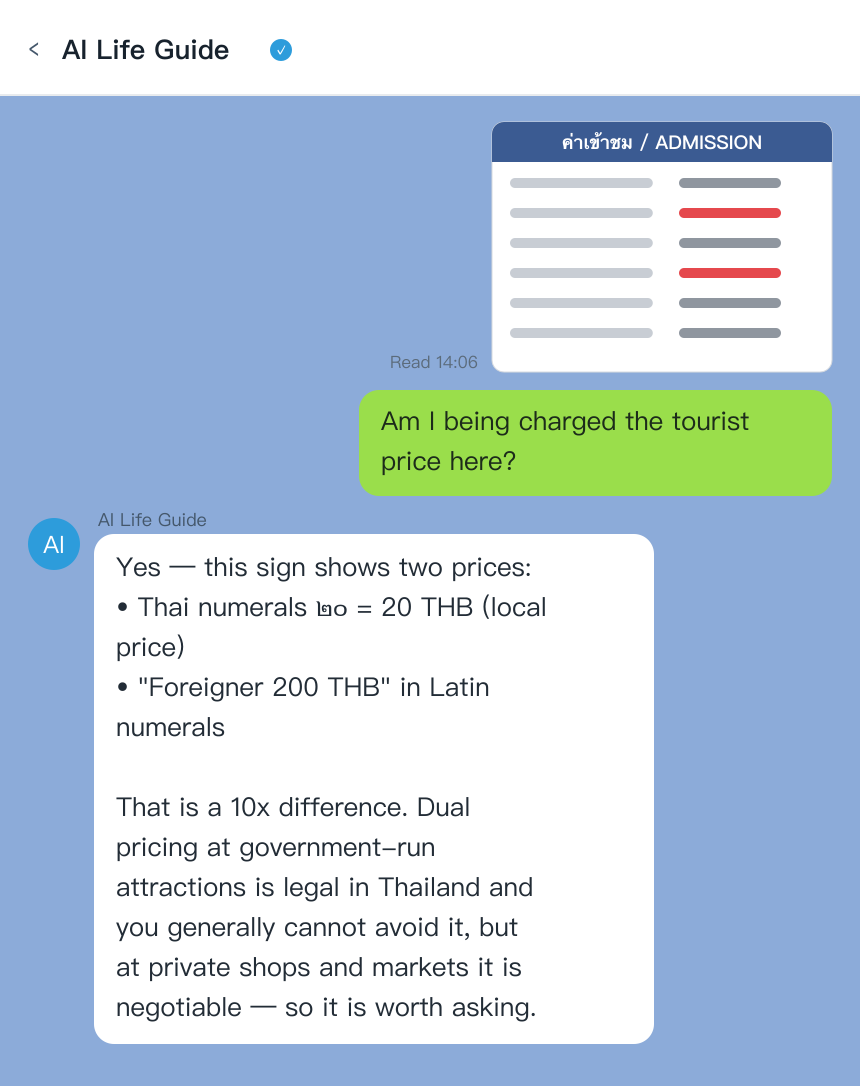
AI Life Guide demo: photograph a Thai price board or ticket sign in LINE and get an instant plain-English explanation (simulated screenshot)
It reads the text and explains what you're looking at — a price, a set of contract terms, a fee schedule — so you know what you're agreeing to before you hand over cash or a passport.
Honest limits
A photo of a document or a price board is a first screen, not a guarantee. It can tell you what a piece of paper says; it can't tell you whether the person handing it to you is trustworthy, and it can't verify a stranger's intent on the street. Use it to understand what you're reading — keep using your own judgment about who you're dealing with, and treat a clear explanation of the terms as one input alongside your own observations, not a replacement for them.
Want a second opinion before you sign anything? Add AI Life Guide on LINE (free) and photograph the contract or price board first.
Scam quick-reference
- Scam: Tuk-tuk "closed today" | Opens with: Attraction is "closed" | Tell: Redirected to gem/tailor shop | Response: Check at the gate yourself
- Scam: Broken meter | Opens with: Meter "doesn't work" | Tell: Flat fare is inflated | Response: No meter, no ride
- Scam: Jet-ski/motorbike deposit | Opens with: Pre-existing damage claim | Tell: No photos taken at pickup | Response: Photograph the vehicle first
- Scam: "Special tour" tout | Opens with: Today-only discount | Tell: Padded shop stops | Response: Compare prices first
- Scam: Friendly-stranger detour | Opens with: Unsolicited "better" tip | Tell: Steers to a specific shop | Response: Thanks, I'll look it up myself
FAQ
Q: Are tuk-tuks always a scam?
A: No. Most tuk-tuk rides are ordinary transactions with no issue at all. The specific pattern to watch for is a driver who volunteers that a major attraction is closed and offers an alternative — that combination is the tell, not tuk-tuks in general.
Q: What do I do if a taxi refuses the meter?
A: Get out and flag another taxi, or open Grab instead. There is almost always another car within a few minutes in any area with tourist traffic, and paying a flat "no-meter" fare just confirms it works as a tactic.
Q: Is the Grand Palace ever actually closed?
A: Rarely, and when it is, the closure is posted officially at the gate or on the palace's own channels — not announced first by a stranger on the street. If someone tells you it's closed before you've even reached the entrance, treat that as reason to check for yourself rather than reason to change plans.
Q: Should I rent a jet ski in Thailand?
A: Plenty of travelers do so without incident, but the damage-deposit scam is common enough to prepare for. Photograph and video the vehicle from every angle before you ride, avoid leaving your passport as collateral if a cash deposit is an option, and choose operators with visible reviews where possible.
Q: How do I check if a price is fair?
A: Compare against your hotel desk or a booking app before accepting a street-side offer, and remember that "today only" urgency is usually manufactured. For a price board you can't read, a photo translated in plain English tells you what it actually says before you commit.
Bottom line
The scams that actually happen in Thailand are a short, recognizable list — not a reason to be suspicious of every friendly stranger, just a reason to recognize five specific openings when you hear them. Default to Grab, the rail network, and the meter, know what dual pricing and service charges legitimately look like, and use a photo to get a second opinion before you sign or pay for anything you can't fully read.
Heading to Thailand soon? Add AI Life Guide on LINE (free) so you can check a price board or contract the moment you need to.
Further reading
- Paying in Thailand as a Foreigner (2026): PromptPay, ATM fees, and what actually works
- Dual Pricing in Thailand (2026): how to read the Thai-numeral price
- Thailand Travel Apps to Download (2026)
- Thai Street Food Ordering Guide
Sources
- Japan Tourism Agency & Thai tourism authority data, 2024–2026
- US Embassy Thailand advisory
- Traveler forum reports and hands-on testing, 2026