Dual Pricing in Thailand (2026): How to Read the Thai-Numeral Price You're Not Meant to See
Thailand's dual-pricing system charges foreigners more at many attractions — and the local price is often written in Thai numerals. Here's how to read it and what's actually legal.
**Quick summary — 3-minute read**
• Dual pricing — a higher ticket price for foreign visitors — is common in Thailand and legal at government-run attractions like national parks.
• The local price is often written in Thai numerals (๐๑๒๓๔๕๖๗๘๙) specifically so foreign visitors can't easily read it.
• Learning ten characters lets you read most price boards in seconds — this guide includes the full cheat table.
• At government attractions the higher price is standard policy that funds upkeep; at markets and private shops, it's more opportunistic and often negotiable.
• A translation tool like Google Lens will read the Thai text for you, but it won't tell you "this is the local price and you're being quoted several times more" — that framing gap is the actual problem.
Stand in front of a ticket counter at a Thai national park or temple, and you'll sometimes see two numbers: a lower one, and a higher one for foreign visitors. This is dual pricing, and it's a well-known, officially acknowledged practice — not a secret scam, though it can feel like one the first time you notice it. What surprises most first-time visitors more is the second layer: the lower, local price is often written in Thai numerals, a completely different number system from the Arabic numerals (0-9) used almost everywhere else in the country.
This guide explains what dual pricing actually is, where it's official policy versus where it's just opportunistic, how to read Thai numerals in under a minute, and how to think about when it's worth pushing back.
What dual pricing actually is
Dual pricing means a venue charges foreign visitors a different, usually higher, ticket price than Thai nationals — commonly somewhere in the range of two to ten times the local price, depending on the attraction. It's most visible at national parks, government-run historical sites, and some temples, where the pricing is posted openly on a sign at the entrance rather than hidden.
The practice isn't unique to Thailand — a number of countries with heavy tourist traffic relative to local income levels run some version of a two-tier pricing system for major attractions. What makes Thailand's version distinctive, and what trips up more visitors than the price gap itself, is the numeral layer stacked on top of it.
Why it exists
The usual rationale, echoed by park and site operators, is straightforward: foreign visitors are generally paying tourists with disposable income earmarked for the trip, while local prices are set closer to what residents can reasonably afford for something many of them consider part of their own national heritage. The foreigner price effectively subsidizes upkeep, conservation, and staffing at sites that see disproportionate tourist wear relative to their local visitor numbers. Whether that rationale feels fair to any individual traveler is a separate question from whether the policy is real, consistent, and legal — it is all three.
Where it's legal and standard vs where it's just opportunistic
Legal and standard: national parks and government-run attractions operate dual pricing as official policy, generally justified as funding maintenance and conservation with the understanding that foreign visitors are typically paying tourists rather than local taxpayers who already fund the site indirectly.
Opportunistic: markets, private shops, and unmetered transport like tuk-tuks have no official dual-pricing policy at all — any price difference there is just a vendor charging what they think a foreign visitor will pay, which is a different situation entirely and one where negotiating or simply knowing the going rate matters more.
- A useful rule of thumb: if the price is posted on an official sign at a gate with a ticket window, it's policy. If it's quoted verbally by an individual vendor with no sign in sight, it's a negotiation.
The Thai-numeral mechanic
Thai has its own set of numerals, distinct from the Arabic numerals (0-9) used on most modern signage in Thailand. Where a price board wants to show a local price without foreign visitors reading it at a glance, it's often written in Thai numerals instead — not necessarily out of secrecy in every case, but the effect is the same: most foreign visitors simply can't read it.
- Thai: ๐ | Arabic: 0
- Thai: ๑ | Arabic: 1
- Thai: ๒ | Arabic: 2
- Thai: ๓ | Arabic: 3
- Thai: ๔ | Arabic: 4
- Thai: ๕ | Arabic: 5
- Thai: ๖ | Arabic: 6
- Thai: ๗ | Arabic: 7
- Thai: ๘ | Arabic: 8
- Thai: ๙ | Arabic: 9
Worked examples
- ๒๐ = 2, 0 → 20
- ๑๐๐ = 1, 0, 0 → 100
- ๒๕๐ = 2, 5, 0 → 250
- ๔๐ = 4, 0 → 40
- ๑๒๐ = 1, 2, 0 → 120
Once you can match each character to its Arabic digit, reading a Thai-numeral price board is a matter of seconds, not a language skill — it's closer to memorizing a substitution code than learning to read Thai. Some signs mix systems on the same board, showing the foreigner price in familiar Arabic numerals right next to the local price in Thai numerals, which is actually the easiest version to practice on: you can check your reading against the number you already understand.
It's also worth knowing that Thailand's Arabic-numeral signage is everywhere — street addresses, most menus, transit fares — so Thai numerals aren't something you'll need constantly. They tend to cluster specifically around the situations covered in this guide: dual-pricing boards and some older or more traditional signage, which is exactly why learning ten characters pays off disproportionately to the effort.
The practical stance
At government attractions, the honest recommendation is usually to just pay the posted foreigner price — it's standard policy, it's openly posted rather than hidden, and it genuinely does fund the upkeep of sites that see heavy tourist traffic. Arguing at a national-park gate rarely changes anything, since the staff are following posted policy, not making a personal judgment call about you.
At markets and with private vendors, it's a different situation — prices there are often genuinely negotiable, and simply knowing what the local price actually is changes the conversation from guessing to negotiating from an informed position.
Why Google Lens doesn't solve this
Point a translation app at a Thai-numeral price board and it will generally convert the characters to a number correctly — that part works fine. What it won't do is tell you that the number it just translated is the local price, and that the price posted for you is several times higher. Translation converts text; it doesn't supply that framing. That gap between "translated the digits" and "understood the pricing situation" is exactly where a conversational tool can help.
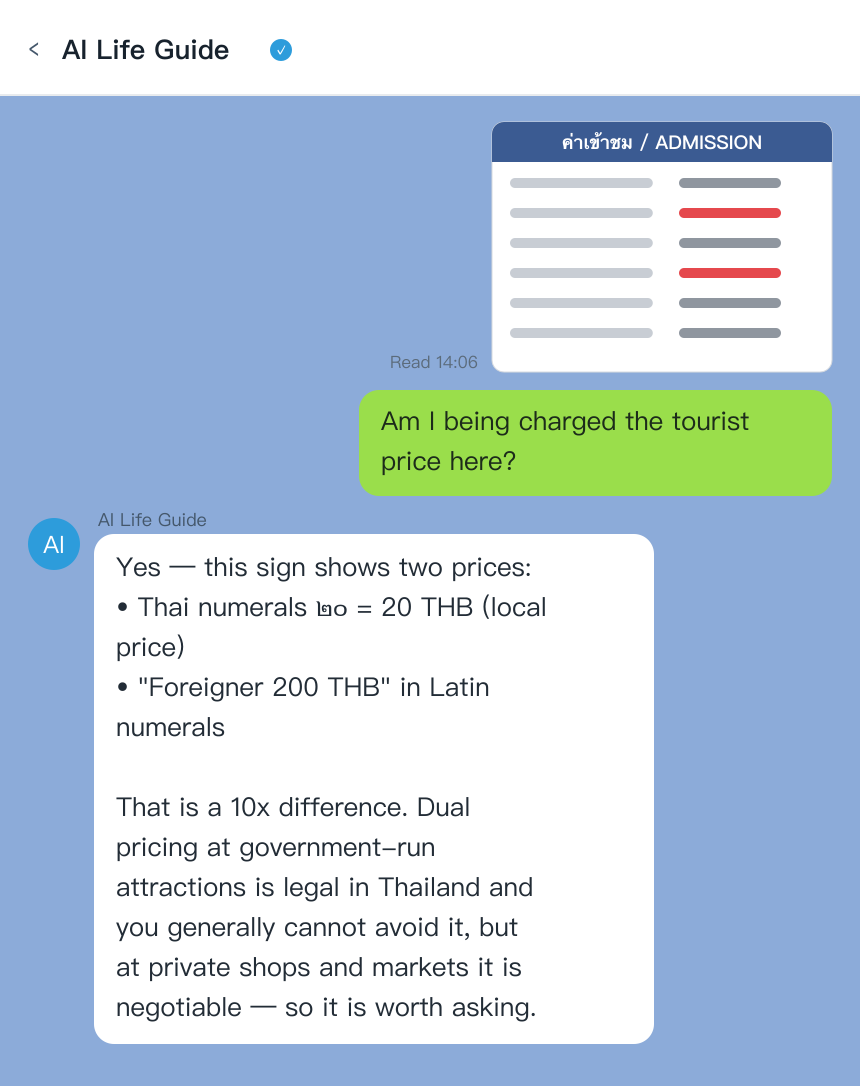
AI Life Guide demo: photograph a Thai price board or ticket sign in LINE and get an instant plain-English explanation (simulated screenshot)
AI Life Guide, a free assistant inside LINE, lets you photograph a price board and ask directly — not just what the numbers say, but what's actually going on: is this dual pricing, which number applies to you, and is this attraction one where paying it is standard or one where it's worth a conversation.
The complaint wave, briefly
Dual pricing generated a wave of visible traveler complaints and social-media attention in 2025, and Thai tourism officials publicly acknowledged the concern and committed to reviewing the practice. Nothing here should be read as a prediction of specific policy changes — check current signage and official guidance at the specific attraction you're visiting, since practices can and do shift.
It's worth being measured about this: the complaints weren't primarily about the existence of a foreigner price, which is broadly accepted as normal at heritage and conservation sites in many countries. They centered more on the size of the gap at some attractions, and on the numeral-switching itself feeling less like transparent policy and more like an obstacle. Whatever comes of the review, the underlying mechanics in this guide — where dual pricing applies, and how to read the numerals when it does — are useful regardless of how the policy debate settles.
Honest limits
A photo can tell you what a number says and give you general context about dual pricing as a practice. It can't tell you the exact policy of every individual attraction, and it can't negotiate a market price on your behalf. Use it to understand what you're looking at, then make your own call about whether to pay, ask, or move on.
Want to know what that price board actually says? Add AI Life Guide on LINE (free) and photograph it before you pay.
Dual pricing quick-reference
- Setting: National parks | Foreigner price?: Yes, standard policy | Worth negotiating?: No — pay the posted rate
- Setting: Government temples/sites | Foreigner price?: Often, posted openly | Worth negotiating?: No — pay the posted rate
- Setting: Markets | Foreigner price?: Sometimes, unofficial | Worth negotiating?: Yes — knowing the number helps
- Setting: Private shops/tuk-tuks | Foreigner price?: Sometimes, unofficial | Worth negotiating?: Yes — knowing the number helps
FAQ
Q: Is dual pricing legal in Thailand?
A: Yes, at government-run attractions such as national parks and many official historical or cultural sites, dual pricing is standard, openly posted policy rather than a scam. It's a different situation at markets and private shops, where any price gap is informal and not backed by official policy.
Q: How do I read Thai numerals?
A: Thai numerals (๐๑๒๓๔๕๖๗๘๙) map one-to-one to Arabic digits 0-9 — once you memorize the ten characters, reading a price like ๒๕๐ becomes as simple as reading 250. It's a short substitution table, not a language skill, and this article includes the full cheat table above.
Q: Can I get the local price?
A: At government attractions, generally no — the dual-pricing policy applies specifically to foreign visitors regardless of effort, and it's not something staff can override. At markets and with private vendors, knowing the local price (often shown in Thai numerals) gives you a real starting point for negotiating rather than guessing.
Q: Which attractions charge foreigners more?
A: As a category, national parks and many government-run historical and cultural sites are the most likely to post an official foreigner price. Coverage and amounts vary by specific site and can change, so check the posted signage at the attraction itself rather than assuming a fixed rule applies everywhere.
Q: Is it worth arguing about?
A: At a government attraction, generally not — the pricing is official policy enforced uniformly, and arguing rarely changes the outcome. At a market or with a private vendor, it's less about arguing and more about negotiating from a position of actually knowing the local price, which is a more productive use of the same information and tends to land better with vendors than an accusation of overcharging.
Bottom line
Dual pricing in Thailand is real, officially acknowledged, and legal where it's government policy — the practical skill worth having isn't outrage, it's literacy: recognizing when a higher price is standard policy worth just paying, and when it's a market price worth knowing before you negotiate. Ten Thai-numeral characters and a sense of which category you're in cover most situations you'll actually encounter, and the gap between "translated" and "understood" is exactly where a quick photo and a question can close the distance.
Standing at a price board you can't read? Add AI Life Guide on LINE (free) and ask what it actually says.
Further reading
- Thailand Tourist Scams 2026: the ones that actually happen
- Paying in Thailand as a Foreigner (2026): PromptPay, ATM fees, and what actually works
- Thai Street Food Ordering Guide
- Menu Translation Apps for Asia 2026
Sources
- Japan Tourism Agency & Thai tourism authority data, 2024–2026
- US Embassy Thailand advisory
- Traveler forum reports and hands-on testing, 2026