Cash or Card in Japan 2026: Where You Still Need Yen, IC Cards, and ATMs That Take Foreign Cards
Japan's cashless ratio has climbed past half, but shrines, small eateries, and ticket machines still run on cash — here's how to know which is which before you order.
**Quick summary — 3-minute read**
• Japan's cashless payment ratio reached 58% in 2025 (METI) — but cash-only spots concentrate exactly where travelers most want to go.
• Shrines and temples, small rural eateries, traditional market stalls, some taxis, and many ramen-shop ticket machines still expect cash.
• Suica, PASMO, and ICOCA (IC cards) cover trains, buses, convenience stores, and vending machines — but not everything, and topping them up is often cash-only.
• 7-Eleven and Japan Post ATMs are the standard, reliable answer for withdrawing yen with a foreign card.
• The real problem isn't Japan's infrastructure — satisfaction with contactless payment is generally high — it's simply not knowing the rules before you're standing at the register.
Japan's reputation as a cash-only country is increasingly outdated, and yet the advice to "bring plenty of yen" hasn't gone away — because it's still partly true, just not evenly. The real issue for most travelers isn't that Japan lacks card infrastructure; it's not knowing, ahead of time, which exact places will and won't take a card.
This guide covers where cards genuinely work and where they don't, how IC cards fit into the picture, which ATMs reliably dispense yen to a foreign card, and a framework for how much cash to actually carry depending on the kind of trip you're taking.
Where cards work, where they don't
Japan's official cashless payment ratio reached 58% in 2025, according to METI — a meaningful majority, and a sign that contactless and card payment is now the norm at convenience stores, department stores, chain restaurants, and most hotels. Traveler satisfaction with contactless payment where it's available is generally high; this isn't a story about broken infrastructure or Japan lagging behind other developed countries on payment technology.
The gap is that the remaining cash-heavy share of transactions concentrates in exactly the places travelers spend a disproportionate amount of their trip: shrines and temples (offerings, omamori charms, goshuin stamp fees), small family-run eateries and izakaya, traditional market stalls, a meaningful share of taxis, and many ramen-shop ticket machines that predate contactless payment entirely. In other words, the 42% of transactions still happening in cash isn't spread evenly across the economy — it's concentrated in the small, traditional, and tourist-beloved end of it.
This is why the "is Japan cashless now" question doesn't have a single clean answer. A traveler who sticks to convenience stores, department stores, and chain restaurants can genuinely go most of a trip barely touching cash. A traveler who prioritizes small ramen counters, rural temples, and market breakfasts will hit cash-only moments regularly, often several times a day.
- Venue type: Convenience stores & chain restaurants | Card acceptance: High | Cash need: Low
- Venue type: Department stores & hotels | Card acceptance: High | Cash need: Low
- Venue type: Shrines & temples (offerings, charms) | Card acceptance: Low to none | Cash need: High
- Venue type: Small rural eateries & family-run shops | Card acceptance: Low | Cash need: High
- Venue type: Traditional market stalls | Card acceptance: Low | Cash need: High
- Venue type: Taxis | Card acceptance: Mixed | Cash need: Medium — carry backup
- Venue type: Ramen-shop ticket machines | Card acceptance: Often cash-only | Cash need: Medium to high
IC cards (Suica / PASMO / ICOCA)
IC cards are Japan's rechargeable transit cards — Suica and PASMO in the Tokyo area, ICOCA around Osaka and Kyoto — and they're genuinely one of the most useful things a visitor can set up before a trip. Tap the card at a train, subway, or bus gate instead of buying a paper ticket, and the same card typically works at convenience stores and vending machines for small purchases too. The three networks are broadly interoperable with each other for transit and store payments across most of the country, so a Suica card bought in Tokyo will generally still work on an Osaka subway gate.
iPhone users can generally add Suica directly inside the Wallet app before ever landing in Japan, and Android users can typically do the same with a compatible device through Google Pay or the Suica app — no physical card needed either way. Topping up ("charging") from your phone with a linked credit card is usually straightforward, though card-issuer compatibility varies, so it's worth testing before you rely on it. Setting this up before you fly, rather than after landing jet-lagged, is one of the highest-value five minutes you can spend on trip prep.
- What an IC card can't always pay for: many restaurants, most shrines and temples, and plenty of small shops don't accept it even though they'll happily take cash — it's a transit-and-convenience-store tool first, not a universal payment card.
- Physical IC card availability has fluctuated over the past couple of years due to a chip shortage — confirm current availability at a station on arrival rather than assuming a physical card will be there if the digital wallet option doesn't suit you.
- Top-up machines at stations are frequently cash-only, even though the card itself can be used for card-based purchases elsewhere — an odd but common mismatch worth expecting.
- A digital IC card in your phone's wallet app avoids the top-up-machine problem almost entirely, since you can typically reload it with a linked card from wherever you are — one more reason to set the digital version up before relying on a physical card.
Getting yen
When you do need cash, the most consistently reliable ATMs for foreign-issued cards are at 7-Eleven convenience stores and Japan Post branches — both are widely regarded as the standard answer among travelers precisely because bank-branch ATMs in Japan are notoriously inconsistent about accepting overseas cards, sometimes rejecting them outright or only operating during limited daytime hours. 7-Eleven ATMs in particular have the advantage of being open around the clock in most locations, which matters if you land late or need cash outside normal banking hours.
Airport ATMs and currency exchange counters are the most convenient option the moment you land, but city-center rates and fees can differ, so it's worth withdrawing a modest amount at the airport to cover your first day or two rather than a large sum at what may not be the best rate you'll find. Once you're settled into a city, a 7-Eleven or Japan Post ATM is usually never more than a short walk away, so there's little reason to carry an unusually large amount at once.
If your card gets declined, it's not necessarily a Japan-specific problem — some banks flag international withdrawals for fraud review by default, and some cards simply aren't supported by a given ATM network. Rather than quoting a specific fee here, check with your own bank before you travel: ask what your card charges for foreign ATM withdrawals and whether you need to set a travel notice, since fees and policies vary considerably by issuer. It's also worth carrying a second card from a different network as a backup, in case one is declined for a reason that has nothing to do with your balance.
How much cash to actually carry
There's no single right number, but the amount you should carry scales with how much of your trip is city-based versus rural or temple-heavy. A city-only itinerary — Tokyo, Osaka, major department stores and chain restaurants — can lean much more heavily on cards and an IC card, with cash mainly as backup for the odd small shop, vending machine, or unexpectedly cash-only izakaya.
A trip with more rural travel, temple-hopping, small-town ryokan stays, or a heavy focus on street food and market stalls should carry meaningfully more cash on hand, since those are exactly the settings where card acceptance thins out fastest. A reasonable approach for most travelers is to withdraw enough at a reliable ATM (7-Eleven or Japan Post) to cover a few days at a time, then top up again once you're back in a city with reliable ATM access, rather than trying to carry your entire trip's cash from day one.
- City-heavy trip: keep a light cash buffer topped up every few days, and lean on cards plus your IC card for most day-to-day spending.
- Rural- or temple-heavy trip: withdraw more before leaving a major city, since ATM access thins out noticeably once you're away from central stations and convenience-store clusters.
Reading the signs so you know before you order
The most avoidable version of this problem is finding out a place is cash-only after you've already ordered. Most restaurants and shops that don't take cards post a small sign — on the door, by the register, or on the ticket machine itself — but it's almost always in Japanese only, and easy to miss if you're not specifically looking for it.
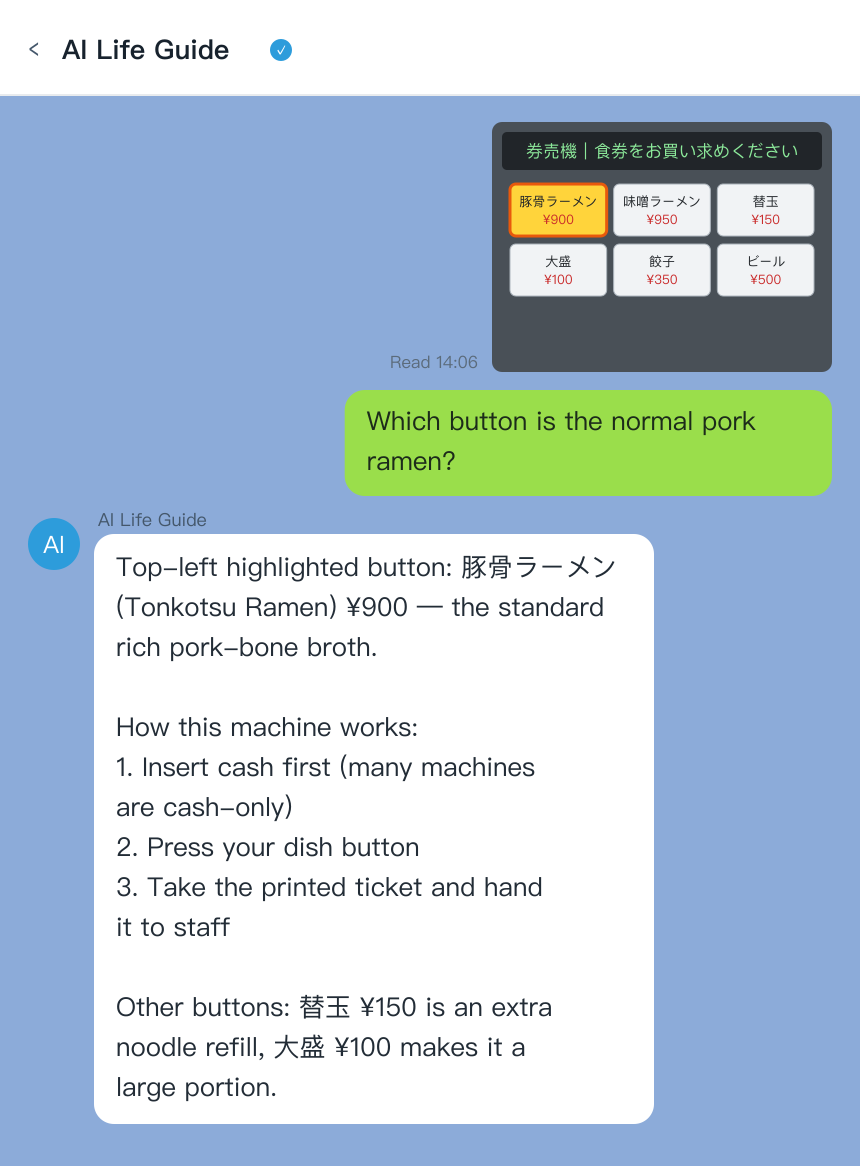
AI Life Guide demo: photograph a ticket machine or door sign to check whether a restaurant is cash-only before you order (simulated screenshot)
Photographing the door sticker, the register-side sign, or the ticket machine itself and asking whether it mentions cash-only or which cards it accepts takes a few seconds and avoids an awkward moment mid-meal. The same approach works on an IC-card top-up machine screen at a station — photograph it and ask which button adds value, since the interface is rarely labeled in English and layouts differ between Suica, PASMO, and ICOCA machines.
It also works in reverse: if you're not sure whether a ticket machine at a small restaurant lets you pay by card at all, photographing the machine's payment icons — before you've queued up and ordered — tells you what to expect rather than discovering it after your food arrives.
- Honest limit: a photo can tell you what a sign or screen says, but it can't guarantee the machine or register will actually accept your specific card — some acceptance issues only show up at the point of payment.
- Honest limit: signage explaining payment rules is sometimes simply absent — some small shops expect regulars to already know they're cash-only, and there's no substitute for asking directly if nothing is posted at all.
Not sure if that door sticker means cash-only? Add AI Life Guide on LINE (free) and photograph it before you sit down.
FAQ
Q: Is Japan still a cash country in 2026?
A: Not primarily — Japan's cashless payment ratio reached 58% in 2025 according to METI, and cards or contactless payment work at most convenience stores, chain restaurants, and hotels. Cash still matters specifically at shrines and temples, small rural eateries, market stalls, some taxis, and many ramen-shop ticket machines, so it's a "carry both" situation rather than a cash-only one.
Q: How much cash should I bring?
A: It depends on your itinerary rather than a fixed number — a city-only trip leaning on cards and an IC card needs relatively little cash on hand, while a rural- or temple-heavy trip needs meaningfully more. A practical approach is withdrawing enough from a 7-Eleven or Japan Post ATM to cover a few days at a time and topping up as you go.
Q: Which ATMs accept foreign cards?
A: 7-Eleven convenience store ATMs and Japan Post branch ATMs are the most consistently reliable options for foreign-issued cards across Japan. Regular bank-branch ATMs are less predictable — some don't accept overseas cards at all, and many keep limited daytime hours, so they're not a dependable first choice.
Q: Can I put Suica on my iPhone?
A: Yes — iPhone users can typically add Suica directly in the Wallet app before ever landing in Japan, then top it up from a linked credit card. Android users can generally do the same with a compatible device through Google Pay or the Suica app, though compatibility depends on the specific device and card issuer.
Q: Why was my card declined in Japan?
A: It's not necessarily specific to Japan — some banks automatically flag international transactions for fraud review, and not every card network is supported by every ATM or terminal. Check with your own bank before traveling about foreign transaction handling and any travel notice they recommend, since policies and fees vary by issuer.
Bottom line
Japan isn't a cash-only country anymore, and it isn't a cards-everywhere country either — it's a place where the two systems overlap unevenly, and the trouble is almost always not knowing which one applies until you're at the register. Set up an IC card before you land, keep a reasonable cash buffer scaled to how rural or temple-heavy your trip is, and know where the reliable ATMs are before you need one.
Heading somewhere that might be cash-only? Add AI Life Guide on LINE (free) and check the sign before you commit to ordering.
Further reading
- How to Book a Restaurant in Japan Without Speaking Japanese (2026)
- 10 Apps to Download Before Your Japan Trip (2026) — And the One Hiding Inside LINE
- Tokyo, Osaka & Kyoto in One Trip (2026): Routes, Day Plans, and the Golden-Route Mistakes to Skip
- Best Japan Travel Translation Apps 2026: 6 Tools Tested for Menus, Signs & Pharmacies
Sources
- Japan Tourism Agency traveler survey, 2024–2025
- METI cashless payment statistics, 2025
- Hands-on testing and traveler forum reports, 2026