How to Order Thai Street Food When You Can't Read Thai (2026): Carts, Menus, and Spice Survival
A practical guide to ordering at Thai street food carts and markets without reading Thai — how ordering culture actually works, the real spice problem, and what to ask before you eat.

**Quick summary — 3-minute read**
• Thailand's best food is often at carts and market stalls with no English menu, no picture menu, and sometimes no menu at all.
• "Mai phet" ("not spicy") doesn't always mean what you think it means at a som tam cart — Thai spice baselines run hotter than most visitors expect.
• Thai script has no spaces between words, which is a big part of why camera-translation apps struggle with it more than they struggle with Japanese or Korean.
• Shrimp paste, fish sauce, and peanuts hide in dishes that don't look like they'd contain them — always worth a direct question before you order.
• LINE is Thailand's most-used messaging app, and AI Life Guide lives inside it — photograph a cart sign or dish and ask what it is, in plain English, for free.
The best meal of a Thailand trip is rarely at a restaurant with an English menu. It's at a cart on a side street with a hand-painted sign, or a stall in a night market where the vendor has made the same three dishes for twenty years and never needed to write them down in English. That food is genuinely some of the best in the country — and it's also where English-speaking travelers get stuck, because there's often zero English anywhere near it.
This guide covers how street food ordering actually works, the spice question that trips up more people than anything else, how to read a sign you can't read, a cheat sheet of common dishes, and what to watch for if you have allergies or dietary restrictions — plus how to use your phone as a translator that explains, not just a scanner that spits out garbled text.
How street food ordering actually works
Thai street food culture runs on a few unwritten rules that make ordering easier once you know them, even without shared language.
- Point-and-order is completely normal: pointing at a dish, a photo, or another customer's plate and holding up fingers for quantity is standard practice, not rude. Vendors who serve tourists regularly are used to it.
- Pricing is per dish, not per menu: most carts sell one or two things, sometimes with a size or protein choice (pork, chicken, tofu). Prices are frequently posted on a small sign near the cart, even when nothing else is in English.
- Sharing tables is the default at markets: communal seating near a cluster of carts is common — you can order from multiple stalls and eat at the same table, so don't assume one cart owns the seating.
- Cash is still king: many carts and small stalls don't take cards or QR payment, especially outside Bangkok's more touristed areas. Small bills and coins save everyone time.
The spice problem
This is the single most common way a good street food order goes wrong for visitors, and it's worth taking seriously.
Saying "mai phet" ("not spicy") at a som tam (green papaya salad) cart doesn't reliably get you a mild dish. Som tam is built around fresh chilies pounded directly into the dish, and a vendor's baseline "not spicy" is often calibrated for a Thai palate, not a visitor's — you can still end up with real heat even after asking for less. Thai spice culture in general runs hotter than what most Western travelers consider mild, and "medium" at a local cart can be closer to "hot" on a scale you're used to elsewhere.
- Be specific, not just polite: "no chili at all" ("mai sai phrik") communicates more clearly than a general "not spicy," especially for dishes like som tam where chili is mixed in during preparation rather than added on top.
- Ask before you order, not after: once chilies are pounded into a salad or stirred into a curry base, there's often no walking it back — the moment to ask is before the vendor starts cooking, not after the plate arrives.
- Watch what locals are ordering, and don't assume it's your baseline: a dish a local vendor considers mild may still be genuinely spicy by most outside standards — it's a different reference point, not a lower one.
Reading cart signs and menus
Thai script doesn't use spaces between words the way English or even Japanese and Korean partially do, which is a real technical obstacle for camera-translation tools — they have to guess where one word ends and the next begins before translation even starts, and that guess is often wrong on a handwritten sign with inconsistent spacing and stylized lettering.
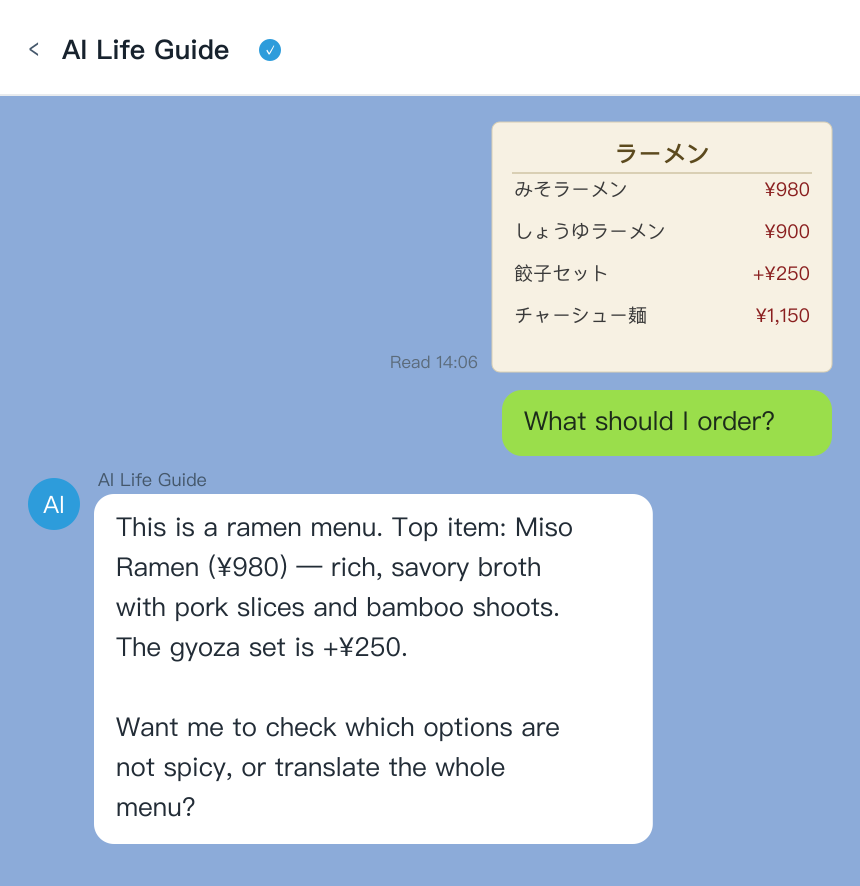
AI Life Guide demo: send a photo of a street-food menu board in LINE and get an instant English explanation of what each dish is (simulated screenshot)
(The demo above shows a Japanese menu, but the flow is identical for Thai: photograph the sign or dish, ask what it is in plain English, and follow up with your own questions.) Instead of trying to translate a Thai sign word by word, photograph it and ask directly what the dishes are. AI Life Guide reads the whole photo for context — including a hand-painted cart sign with no spacing at all — and explains what's being sold rather than returning a fragmented literal translation. You can then ask something specific: "which one is the noodle soup," "is this the spicy version," "what's in this sauce."
Common dishes cheat sheet
- Pad Thai: stir-fried rice noodles with egg, tofu or shrimp, bean sprouts, and a tamarind-based sauce. Usually mild to moderate — a safe first order for a spice-cautious traveler.
- Som Tam: green papaya salad, pounded with chili, lime, fish sauce, and often dried shrimp. Spice level varies widely by cart and can run hot — see the spice section above before ordering.
- Khao Man Gai: Hainanese-style poached chicken over rice cooked in chicken fat and broth, served with a ginger-chili dipping sauce on the side. Mild on its own; the sauce is where the heat lives, and it's usually separate.
- Moo Ping: grilled marinated pork skewers, often sold from a cart with sticky rice. Generally mild and one of the easiest street-food orders for a first-timer.
- Boat Noodles: a rich, dark broth (often with a hint of blood as a thickener in traditional versions) served in small bowls meant to be ordered several at a time. Worth asking about specific ingredients if you're unsure what's in the broth.
Allergies and dietary needs
Thai cooking uses a handful of ingredients that hide in dishes where you might not expect them, which matters if you're managing an allergy or a dietary restriction.
- Shrimp paste and fish sauce: these appear in a huge range of dishes that don't look seafood-based at all — many vegetable stir-fries and salads use fish sauce as a base seasoning, so "vegetarian-looking" isn't the same as vegetarian.
- Peanuts: common in sauces (especially satay and some pad Thai preparations) and as a garnish — always worth asking directly if you have a peanut allergy, since it's not always visible on the plate.
- Halal availability: halal carts and stalls exist in a number of areas, particularly with larger Muslim communities, but availability varies by neighborhood and city — verify directly with the vendor rather than assuming based on the area.
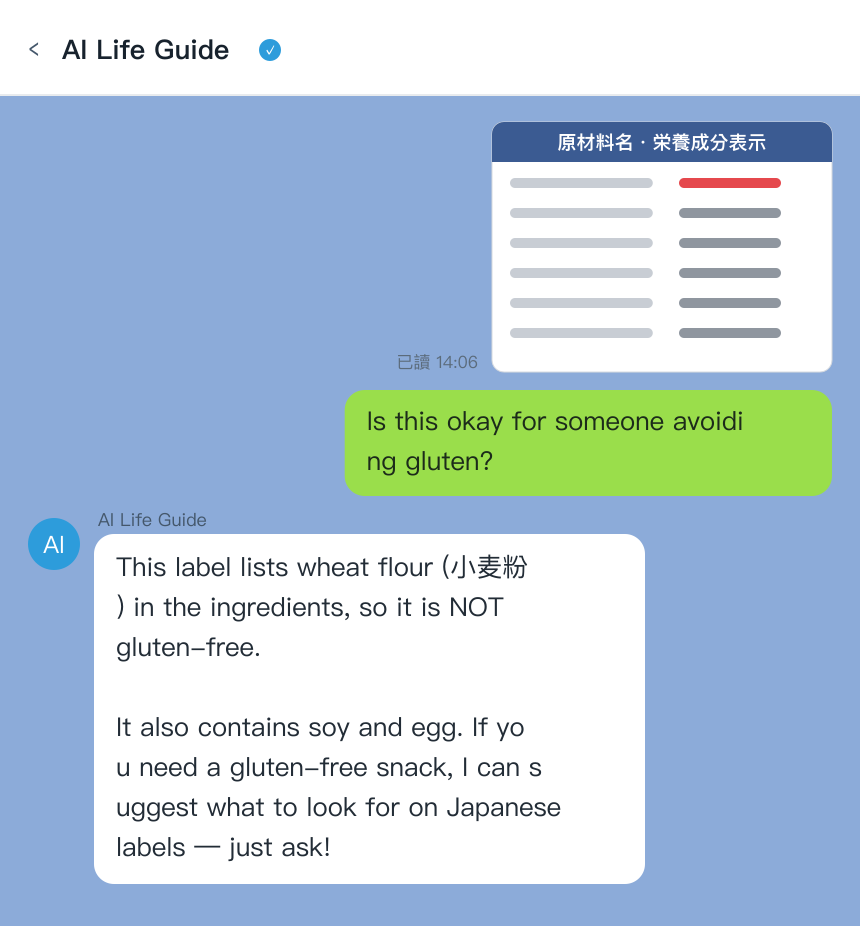
AI Life Guide demo: photograph a food label or ingredient list and ask about allergens in English (simulated screenshot)
Treat AI Life Guide as a first screen for figuring out what's likely in a dish, then confirm directly with the vendor — a photo and a translated question ("does this have peanuts," "is this made with fish sauce") is a fast way to ask clearly even without shared language, but a direct human confirmation is still worth getting for anything serious.
Heading into a night market tonight? Add AI Life Guide on LINE (free) — a $1.49 day pass covers a whole night of cart-hopping.
Pointing vs Google Translate vs AI Life Guide
- Method: Pointing / gestures | Works for ordering: Yes, for simple orders | Explains the dish: No | Handles allergies: Risky, easy to misunderstand | Price: Free
- Method: Google Translate | Works for ordering: Partial, literal only | Explains the dish: No | Handles allergies: Translates the question, not the answer | Price: Free
- Method: AI Life Guide | Works for ordering: Yes | Explains the dish: Yes | Handles allergies: First screen + confirm with vendor | Price: Free 5/day, $3.99/mo, $34.99/yr, $1.49 day pass
FAQ
Q: Is street food in Thailand safe to eat?
A: Generally, yes — Thai street food is eaten daily by millions of locals, and busy carts with high turnover tend to have the freshest ingredients. Basic sense still applies anywhere in the world: pick stalls with a steady stream of local customers, watch for food cooked fresh to order rather than sitting out for long periods, and carry the usual travel precautions (bottled water, hand sanitizer) that apply to eating out in any new country.
Q: How do I order not-spicy food in Thailand?
A: Ask for "mai sai phrik" (no chili) rather than just "mai phet" (not spicy) — it's more specific and communicates better, especially for dishes like som tam where chilies are mixed in during preparation. Ask before the vendor starts cooking, since chili worked into a salad or curry base often can't be removed afterward. Keep in mind that a local vendor's idea of mild can still run hotter than what you're used to.
Q: How do I know what a Thai dish actually is?
A: Photograph the cart sign, the dish, or the menu and ask AI Life Guide on LINE what it is — it explains the dish in plain English rather than returning a literal, often garbled translation of Thai script, which is especially useful since Thai has no spaces between words for OCR tools to work with. You can then ask follow-up questions about spice, ingredients, or how it's eaten.
Q: Do Thai street vendors speak English?
A: It varies a lot by location. Vendors in heavily touristed night markets often know enough English for basic ordering, while carts in local neighborhoods frequently don't — which is exactly where a photograph-and-ask tool is most useful, since it doesn't depend on the vendor speaking English at all.
Q: What app reads Thai menus?
A: Google Translate's camera mode works as a free first pass but struggles with Thai's lack of word spacing and handwritten cart signs. AI Life Guide, a free assistant inside LINE — Thailand's most widely used messaging app — reads the whole photo for context and explains what a dish is rather than returning a fragmented literal translation, then takes follow-up questions about ingredients and spice.
Bottom line
The best Thai street food is worth the effort of ordering it without shared language — point, ask about spice before the wok gets hot, and use a tool that explains a dish rather than one that just translates its label. LINE is already the app most locals are using anyway, which makes AI Life Guide a natural fit rather than one more download.
Before your next market crawl, add AI Life Guide on LINE (free) and ask about the first cart sign you can't read.
Further reading
- Menu Translation Apps for Asia 2026: Order Confidently in Japan, Korea, Thailand & Taiwan
- 10 Apps to Download Before Your Japan Trip (2026) — And the One Hiding Inside LINE
- Getting Around Asia 2026: Transit Apps, IC Cards & How to Read Ticket Machines
- 10 apps to download before your Thailand trip
- Dual pricing in Thailand: how to read the Thai-numeral price
- Vegetarian, jay, halal, and allergies in Thailand
Sources
- Official app/tourism documentation, 2025-2026
- Hands-on travel testing, 2026