How to Book a Restaurant in Japan Without Speaking Japanese (2026)
Why phone reservations, Tabelog fees, and Japanese-only waitlist machines trip up foodie trips to Japan — and the six booking routes that actually work.

**Quick summary — 3-minute read**
• Most Japanese restaurants can't take phone reservations in English, and plenty of popular places don't take reservations at all.
• Six realistic booking routes exist — hotel concierge, Tabelog, TableCheck, the restaurant's own site or Instagram, walk-in queuing, and a booking concierge for omakase — each with real trade-offs.
• Tabelog charges a ¥440 system fee for English-language bookings while the Japanese-language side stays free; the platform itself pushed a multilingual app in November 2025 because the gap is real.
• The number-machine and waitlist-tablet queue system many restaurants use is a genuine language barrier of its own, separate from the reservation problem.
• AI Life Guide on LINE can read a ticket machine or waitlist screen and tell you what to press or write — but it can't make a phone call or hold your place in line for you.
Booking a restaurant in Tokyo or Osaka trips up more first-time visitors than almost any other planning task, and it's not because Japanese food culture is unusually difficult — it's because the reservation systems most travelers rely on at home simply don't translate. A phone call, the default fallback everywhere else, is often the one option guaranteed not to work.
This guide walks through why the problem exists, compares the booking routes that actually work for English speakers, explains the ticket-machine and waitlist culture nobody warns you about, and covers what to do when you're already standing outside a restaurant with no reservation and no idea what the sign says.
Why it's hard
Japan Tourism Agency survey data puts the scale of the problem in context: language trouble with staff affects a meaningful share of travelers overall, and restaurants are where it concentrates most — over half of all reported language-barrier incidents happen specifically while dining out. That tracks with what most visitors experience on the ground: a large share of Japanese restaurants, especially smaller and mid-range ones, simply aren't staffed or set up to take a phone reservation in English. Some restaurants only accept bookings by phone at all, with no online alternative. Others — often the most sought-after ones — don't take reservations from anyone, tourist or local, and operate on a first-come, queue-based system instead.
Layer onto that a queue culture built entirely around Japanese-language tools — paper ticket machines, waitlist tablets, a clipboard by the door — and it's easy to see why "just walk up and figure it out" doesn't always work either. None of this means Japan is unusually unwelcoming to foreign visitors; it means the booking infrastructure was built for a domestic audience first, and English support has been added unevenly on top.
1. Hotel concierge
For genuinely hard-to-book restaurants — a small sushi counter, a well-known kaiseki spot, anywhere with a reputation — a hotel concierge is still the highest-success route, especially at mid-range and upscale hotels. Concierges often have existing relationships with restaurants and can call on your behalf in Japanese, sometimes securing tables that aren't bookable any other way.
- Ask as early as possible after check-in, or even before arrival by email if your hotel allows it — some sought-after restaurants book out weeks ahead.
- Not every hotel offers this, and budget or business-hotel chains are less likely to have a dedicated concierge desk than boutique or luxury properties.
2. Tabelog
Tabelog is Japan's dominant restaurant review and reservation platform, and its English-language site can book a real subset of participating restaurants directly. The catch: English-language bookings on Tabelog carry a ¥440 per-reservation system fee, while the same booking made through the Japanese-language site is free. It's a small but telling detail — the platform is charging for the English layer specifically, which says something about how much extra infrastructure that layer requires.
- Tabelog began pushing a multilingual app more heavily starting in November 2025, which reads as the platform itself acknowledging that English-side booking has been underserved and worth investing in.
- Coverage is real but partial — plenty of restaurants listed on Tabelog for reviews still don't offer online booking in either language.
3. TableCheck
TableCheck is a reservation platform built with English-speaking diners more in mind from the start, and restaurants that use it tend to have a smoother English booking flow than Tabelog's. The trade-off is coverage: fewer restaurants use TableCheck than Tabelog, so it's worth checking both before assuming a restaurant isn't bookable online at all.
- Higher-end and internationally-oriented restaurants are more likely to be on TableCheck than small neighborhood spots.
4. The restaurant's own website or Instagram DM
Some restaurants, particularly smaller or newer ones, skip third-party platforms entirely and take reservations through their own website form or by direct message on Instagram. This can be surprisingly effective — restaurant social-media accounts are often checked more attentively than you'd expect — but response times vary widely and there's no guarantee of a reply before your trip.
- Keep messages short and specific: party size, date, time, and that you're a visiting tourist who doesn't speak Japanese — most accounts will reply in whatever language works, sometimes with a translation tool of their own.
5. Walk-in and the queue strategy
For restaurants that don't take reservations at all — and there are genuinely many, including some of the most talked-about ones — walking in and queuing is the only route that exists. Arriving right at opening time, or well before a typical peak (noon and 7pm are the two crunch points for lunch and dinner), meaningfully improves your odds.
- Solo diners and pairs often get seated faster than larger groups, since single counter seats free up more easily than a full table.
6. Omakase and kaiseki through a booking concierge
For the highest tier of dining — an omakase counter or a formal kaiseki restaurant — a growing number of third-party booking concierge services exist specifically to handle these reservations for a fee, often making the initial phone call and vetting first-time-guest etiquette on your behalf. It's a paid, English-fluent version of what a hotel concierge does for a broader range of restaurants.
- Worth the fee mainly for restaurants you've specifically decided are worth the effort, not as a default booking method for an entire trip.
- Route: Hotel concierge | English support: High (human, spoken) | Typical cost: Usually free at the hotel | Best for: Hard-to-book, high-end restaurants
- Route: Tabelog | English support: Moderate (platform) | Typical cost: ¥440 system fee for English booking | Best for: Mid-range restaurants with online booking
- Route: TableCheck | English support: Good, where listed | Typical cost: Usually free | Best for: English-oriented and upscale restaurants
- Route: Restaurant site / Instagram DM | English support: Variable | Typical cost: Free | Best for: Small or new restaurants
- Route: Walk-in / queue | English support: None needed to queue | Typical cost: Free (your time) | Best for: No-reservation restaurants
- Route: Booking concierge service | English support: High (paid, human) | Typical cost: Service fee on top of the meal | Best for: Omakase / kaiseki, once-in-a-trip meals
The queue system nobody explains
Even restaurants that don't require a reservation often run on a queue system with its own unwritten rules, and almost none of it is in English. A paper ticket machine near the entrance dispenses numbered tickets; a waitlist tablet asks you to tap in your party size, sometimes with seating preferences, entirely in Japanese; some places simply keep a clipboard where you write your name and headcount by hand. Whether a seat is "reserved" or "counter only" is often marked on a sign or the tablet itself, and getting it wrong means losing your place.
There's also an etiquette layer around narabi (並び) — the queuing culture itself. Lines form in a specific order, latecomers don't cut in front of a line that's already formed even if it looks informal, and stepping away from a physical queue for more than a few minutes can mean losing your spot without anyone telling you directly.
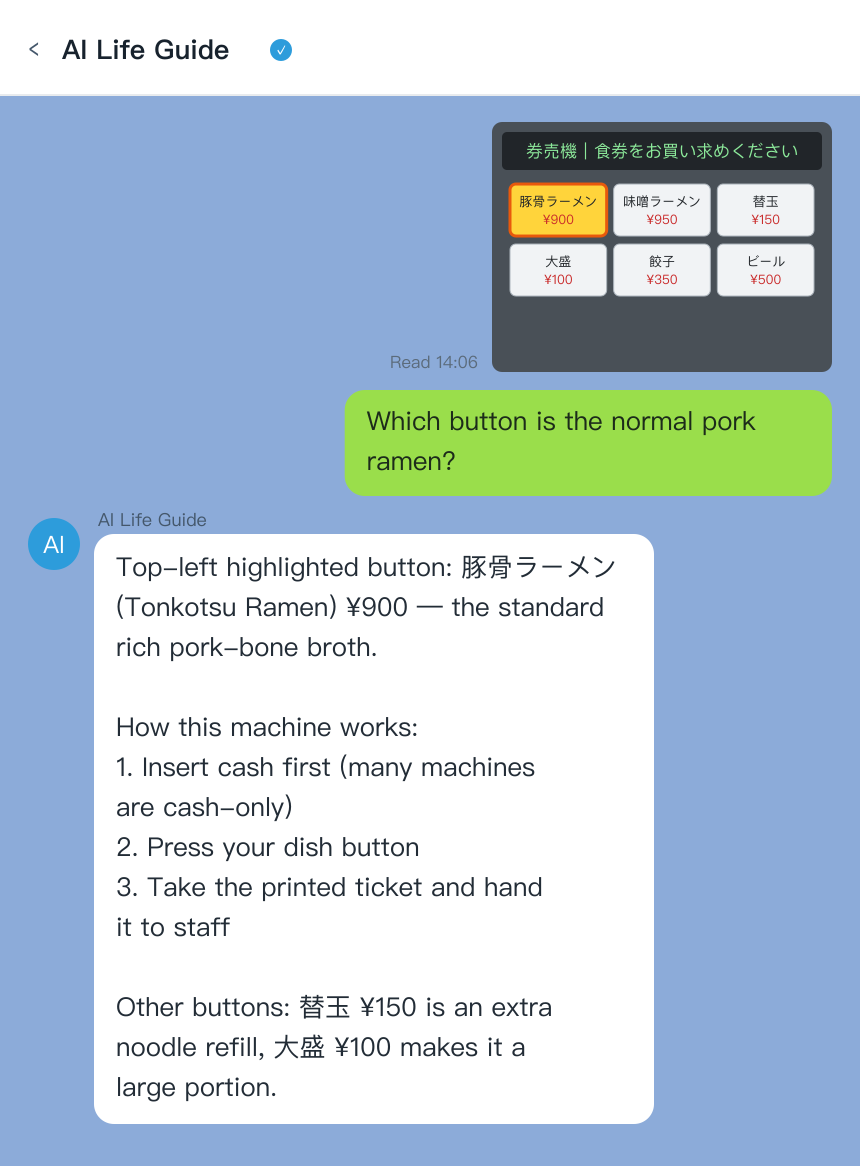
AI Life Guide demo: photograph a restaurant ticket or queue machine to find out what to press or write next (simulated screenshot)
A ticket machine is really the same class of problem as a menu or a station sign: a Japanese-only interface standing between you and something you need — in this case, lunch. The interface changes from restaurant to restaurant, but the underlying issue doesn't.
What to do when you're already standing there
If you're at the door with no reservation and a machine or tablet you can't read, photograph it and ask what it's asking you to do — which button corresponds to your party size, whether it's asking for a name, or what a printed ticket number means for your wait. The same approach works on a handwritten board out front listing today's wait time or last-order cutoff, which some restaurants post instead of turning people away individually.
- Be honest about the limits: a photo-and-ask tool can tell you what a screen or sign says, but it can't make a phone call for you, hold a table, or physically save your place in a line.
- If the machine or tablet has any English toggle at all, it's usually a small flag icon in a corner — worth a quick look before assuming there's none.
When to book, and the etiquette around it
Lunch reservations are generally easier to get last-minute than dinner, and same-day availability is far more common at midday than in the evening, when the most in-demand restaurants often fill up days or weeks ahead. If you have a short list of must-try dinners, book those as early as your travel dates allow and leave lunch more flexible.
No-show culture in Japan is taken seriously — a missed reservation without cancellation isn't just impolite, it can mean a genuinely wasted table and lost revenue for a small restaurant that turned other guests away to hold your slot. Cancel or change a reservation as soon as you know your plans have shifted, ideally through whichever channel you booked (the platform's app, a reply to the confirmation email, or a message to the restaurant directly), and give as much notice as you can.
It's also worth accepting upfront that some legendary, tiny, or single-digit-seat restaurants simply aren't bookable by tourists at all — not because of a language barrier specifically, but because demand from regulars and word-of-mouth already exceeds their capacity. Treat those as a "maybe if you're lucky and try the queue" rather than something a better booking strategy will unlock.
Standing at a ticket machine or waitlist tablet you can't read? Add AI Life Guide on LINE (free) and photograph it for a plain-English read of what to do next.
FAQ
Q: Can I book Japanese restaurants in English?
A: Sometimes, but not by default. Tabelog and TableCheck both offer English-language booking for a subset of restaurants, hotel concierges can call on your behalf, and some restaurants take DMs on Instagram. Many restaurants — especially small, popular, or traditional ones — either don't take reservations from anyone or only take them by phone in Japanese.
Q: Why does Tabelog charge a fee for English bookings?
A: Tabelog's English-language site charges a ¥440 system fee per reservation, while the same booking made through the Japanese-language site is free. The platform hasn't published a detailed explanation, but the fee lines up with the platform itself investing more visibly in English-side tools since pushing a multilingual app starting in November 2025.
Q: Do I need reservations in Japan?
A: For popular or high-end restaurants, yes — especially for dinner, where the best-known places can book out well in advance. For casual spots, chain restaurants, and many lunch counters, walking in and queuing is completely normal and often the only option, since plenty of restaurants don't take reservations at all.
Q: What do I do if the restaurant only takes phone bookings?
A: Ask your hotel concierge to call on your behalf — this is exactly the situation concierge services exist for, and it works even at restaurants with no English-language booking option anywhere online. If no concierge is available, a paid booking concierge service is a realistic backup for a specific must-try restaurant.
Q: How do the number and waitlist machines work?
A: They vary by restaurant, but most either print a numbered paper ticket you keep until you're called, or ask you to enter your party size on a tablet, usually in Japanese only. Photographing the machine or tablet screen and asking what it's asking for is the most reliable way to figure out what to press or write when there's no English option visible.
Bottom line
There's no single trick that makes Japanese restaurant reservations easy for English speakers — it's a genuinely fragmented system, and the right route depends on the restaurant. Lean on your hotel concierge for the meals that matter most, check both Tabelog and TableCheck before assuming a place isn't bookable, and go in expecting that some of the best food you'll eat in Japan will come from simply queuing at the right time of day.
Planning your Japan food itinerary? Add AI Life Guide on LINE (free) so every menu, machine, and sign along the way gets a plain-English read.
Further reading
- How to Read a Japanese Menu Without Speaking Japanese
- Cash or Card in Japan 2026: Where You Still Need Yen, IC Cards, and ATMs That Take Foreign Cards
- 10 Apps to Download Before Your Japan Trip (2026) — And the One Hiding Inside LINE
- Tokyo, Osaka & Kyoto in One Trip (2026): Routes, Day Plans, and the Golden-Route Mistakes to Skip
Sources
- Japan Tourism Agency traveler survey, 2024–2025
- METI cashless payment statistics, 2025
- Hands-on testing and traveler forum reports, 2026