Tokyo, Osaka & Kyoto in One Trip (2026): Routes, Day Plans, and the Golden-Route Mistakes to Skip
A practical guide to Japan's golden route — how many days to budget, how to sequence the three cities, and the common itinerary mistakes worth skipping.
**Quick summary — 3-minute read**
• The Tokyo–Kyoto–Osaka "golden route" works in 7, 10, or 14 days, depending on how much you want to pack in.
• Fly into Tokyo and out of Osaka (or the reverse) to avoid backtracking, then take the shinkansen between cities.
• Don't buy a JR Pass on autopilot — calculate your actual route cost first, since point-to-point tickets are sometimes cheaper.
• The biggest mistakes are overpacking the itinerary, booking a ryokan every single night, and ignoring luggage-forwarding services between cities.
• AI Life Guide on LINE works as an on-the-ground companion — photograph a temple plaque, menu, or station sign and get context in English, with follow-up questions.
Tokyo, Kyoto, and Osaka form Japan's most-traveled route for a reason: three cities with genuinely different personalities, connected by a train line that makes the logistics easy. Tokyo is scale and neon; Kyoto is temples and quiet mornings; Osaka is food and a looser, friendlier pace. The route is popular enough that it's sometimes called the "golden route," and popular enough that first-timers make the same handful of planning mistakes over and over.
This guide covers how many days to budget, how to sequence the cities without wasted travel time, what each city is actually good for, and the mistakes worth skipping — plus how to use your phone as an on-the-ground guide once you're standing in front of something you don't understand.
How many days do you need
7 days: workable, but tight. Realistically 3 nights Tokyo, 2 nights Kyoto, 2 nights Osaka (with Nara as a day trip from Osaka). You'll see the highlights of each city but won't have much slack for a slow morning or a rained-out day.
10 days: the comfortable middle ground most people land on — roughly 4 nights Tokyo, 3 nights Kyoto, 3 nights Osaka. Enough time for one or two neighborhoods per city beyond the must-sees, and a buffer day if something goes wrong.
14 days: lets you slow down meaningfully — add a side trip (Hakone, Hiroshima, or the Japan Alps), spend a full extra day wandering rather than sightseeing, or split Tokyo into an arrival stretch and a final splurge stretch before flying home.
- Whatever the length, resist the urge to add a fourth or fifth city on a first golden-route trip — Tokyo, Kyoto, and Osaka alone comfortably fill the time above without rushing.
Route logic: open-jaw vs round-trip, and the JR Pass question
Open-jaw flights: flying into Tokyo and out of Osaka (or the reverse) avoids backtracking entirely — you move in one direction the whole trip instead of returning to your arrival city to fly home. Most airlines price open-jaw itineraries the same as a round-trip through one city, so it's worth checking before defaulting to a round-trip into Tokyo alone.
The shinkansen leg: Tokyo → Kyoto → Osaka by bullet train is the backbone of the route. Kyoto and Osaka are close enough (under 30 minutes by train) that many travelers base themselves in one and day-trip to the other, which is worth considering if you'd rather unpack once.
The JR Pass, honestly: the nationwide JR Pass is convenient, but it isn't automatically the cheapest option — its value depends entirely on how much long-distance train travel you're actually doing. Add up the point-to-point fares for your specific route (Tokyo–Kyoto, Kyoto–Osaka, Osaka–Tokyo or onward) before buying, since a lighter itinerary with fewer long-haul legs can come out cheaper on individual tickets. Regional passes covering just the Kansai area (Kyoto/Osaka/Nara) are also worth comparing if you're not doing a long Tokyo–Kansai run more than once.
Tokyo highlights by cluster
Tokyo is too spread out to wing day-by-day — group neighborhoods instead of crisscrossing the city.
- Asakusa day: Senso-ji temple and the surrounding market streets in the morning before tour groups arrive, then the Sumida River area and a view of Tokyo Skytree.
- Shibuya/Shinjuku day: Shibuya Crossing and the surrounding shopping streets earlier in the day, Shinjuku's department stores and Golden Gai in the evening — these two are close enough by train to combine comfortably.
- A slower third day: pick one of Ueno (museums, a park), Harajuku/Omotesando (fashion, cafes), or a day trip to Kamakura or Hakone if you have the time to spare.
Kyoto: early mornings and bus vs subway reality
Go early, deliberately: Fushimi Inari, Kinkaku-ji, and Arashiyama's bamboo grove are dramatically different experiences at 7am versus 11am — the first two are free-flowing and quiet, the second is shoulder-to-shoulder with tour groups. If you do nothing else with this guide, set an alarm for your first temple.
Bus vs subway: Kyoto's subway network is limited, so most sightseeing routes rely on buses — which means real traffic delays during peak sightseeing hours, especially around Higashiyama and Arashiyama. Budget extra time rather than assuming bus schedules will hold, and consider a day bus pass if you're making several stops.
- Central Kyoto is genuinely walkable between nearby sights (Kiyomizu-dera to Higashiyama's streets, for example) — don't default to a bus for every short hop.
Osaka: food scene and a day trip to Nara
The food scene: Osaka's reputation as Japan's food city is earned — Dotonbori for the classic street-food crawl (takoyaki, okonomiyaki), and the surrounding backstreets for less touristy options at a slower pace. It's also generally a cheaper, more casual eating city than Tokyo.
Nara as a day trip: Nara is close enough to Osaka (and to Kyoto) to add as a single day without moving hotels — the deer park and Todai-ji temple are the headline stops, and a half-day is enough to see both if you start reasonably early.
- Osaka Castle and the surrounding park are worth a few hours if you have a spare afternoon, though it's a step below Kyoto's temples for most first-time visitors prioritizing time.
Common mistakes to skip
- Overpacking the itinerary: trying to hit every recommended spot in each city leaves no slack for a delayed train, a rained-out morning, or simply being tired. Plan roughly 70% of what you think you can do.
- A ryokan every single night: a traditional ryokan stay is worth doing once on this route, but a full trip of ryokans means repeatedly repacking and adjusting to a different check-in routine — most travelers get more value from one ryokan night (often paired with an onsen) and hotels the rest of the trip.
- Ignoring luggage forwarding: Japan's door-to-door luggage forwarding services (takkyubin) let you ship a suitcase ahead to your next hotel for a fee, arriving within a day or two — genuinely worth it for the Tokyo-to-Kansai leg so you're not dragging bags through train stations and transfers.
Your pocket AI tour guide
A guidebook or an audio tour covers the highlights, but golden-route travel is full of smaller moments a guidebook won't cover: a shrine plaque with no English translation, a temple's information board explaining a ritual you just watched, a restaurant menu with no pictures. That's where AI Life Guide, a free assistant inside LINE, works as an on-the-ground companion.
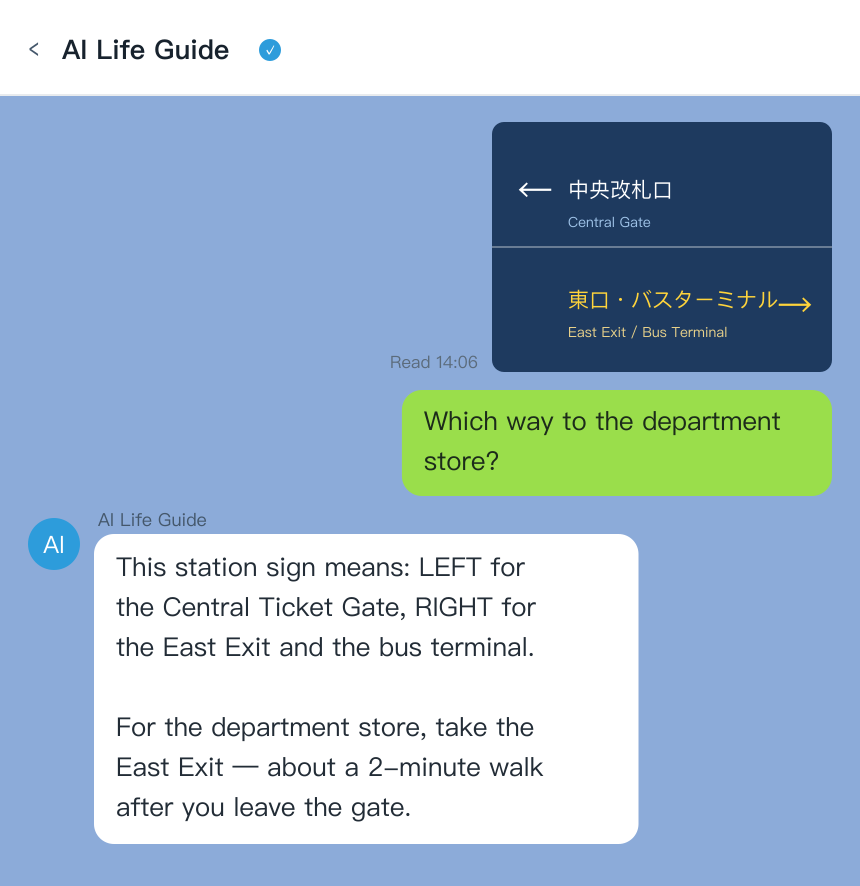
AI Life Guide demo: snap a Japanese station sign and get directions in plain English (simulated screenshot)
Add it as a friend once, and from then on it works the same way in Tokyo, Kyoto, or Osaka: photograph the plaque, sign, or menu in front of you, and ask what it means in plain English. Unlike a static guidebook entry, you can follow up — "why do people wash their hands before entering," "what's the history of this gate," "does this dish contain shellfish" — the same way you'd ask a human guide standing next to you.

AI Life Guide demo: photograph a Japanese food label and check allergens in English (simulated screenshot)
Honest cons:
- It needs an active internet connection, so have an eSIM or pocket WiFi arranged — this matters especially in Kyoto's older temple districts, where signal can be patchy.
- It's a photograph-and-ask tool, not a live audio tour — there's no walking-around narration, just answers when you stop and ask.
- Requires installing LINE, an extra app for travelers who've never needed it before — but it's free and takes about a minute to set up.
Standing in front of a temple sign or menu you can't read? Add AI Life Guide (free on LINE) and ask in plain English.
Trip-length comparison
- Length: 7 days | Tokyo: 3 nights | Kyoto: 2 nights | Osaka: 2 nights | Pace: Tight, highlights only
- Length: 10 days | Tokyo: 4 nights | Kyoto: 3 nights | Osaka: 3 nights | Pace: Comfortable, some slack
- Length: 14 days | Tokyo: 4-5 nights | Kyoto: 3-4 nights | Osaka: 3 nights | Pace: Relaxed, room for a side trip
FAQ
Q: How many days do you need for Tokyo, Kyoto and Osaka?
A: Seven days covers the highlights of all three cities but leaves little slack; 10 days is the comfortable default most travelers choose; 14 days lets you slow down or add a side trip like Hiroshima or Hakone. Match the length to how much downtime you actually want, not just how many sights exist.
Q: Is the JR Pass worth it for the golden route?
A: It depends on your specific route, not on the route type in general. Add up point-to-point fares for the legs you'll actually ride (Tokyo–Kyoto, Kyoto–Osaka, and any return or onward leg) and compare that total to the pass price before buying — a lighter itinerary with fewer long-distance legs can come out cheaper without a pass at all.
Q: Should I stay in Kyoto or Osaka?
A: Both work as a base, since they're under 30 minutes apart by train — Kyoto suits travelers prioritizing temples and early mornings, while Osaka suits those prioritizing food and nightlife. If you don't want to unpack twice, pick one as your base and day-trip to the other rather than splitting nights between them.
Q: What's the best month to do this route?
A: Spring (cherry blossoms) and autumn (fall foliage) are the most popular and most crowded windows, with temple visits and photo spots noticeably busier than the rest of the year. Summer is hot and humid; winter is cooler with thinner crowds and occasional snow in Kyoto. There's no single "best" month — it's a trade-off between scenery and crowd levels, so pick based on which one matters more to you.
Q: How do I understand temple signs and menus in English?
A: Photograph the sign, plaque, or menu and send it to AI Life Guide on LINE, then ask your question directly — what it says, why a ritual is performed, or whether a dish contains something you're avoiding. It works the same way across all three cities, so it's worth setting up once before your trip rather than searching for a new tool in each city.
Bottom line
The golden route works because the logistics are genuinely easy — one train line, three cities with distinct identities, and enough flexibility to fit 7, 10, or 14 days. The mistakes that derail it are almost always about pacing: too many stops, too many different bed types, too much luggage dragged through transfers. Plan lighter than you think you need to, and keep a way to ask questions on the ground for everything a guidebook won't cover.
Build your on-the-ground toolkit before you land — add AI Life Guide on LINE (free) and ask your first question at the first temple gate.
Further reading
- 10 Apps to Download Before Your Japan Trip (2026) — And the One Hiding Inside LINE
- Best Japan Travel Translation Apps 2026: 6 Tools Tested for Menus, Signs & Pharmacies
- Getting Around Asia 2026: Transit Apps, IC Cards & How to Read Ticket Machines
- Cash or card in Japan 2026: IC cards and ATMs that take foreign cards
- Tattoos in Japan: onsen rules, cover-up stickers, and tattoo-friendly baths
Sources
- Official app/tourism documentation, 2025-2026
- Hands-on travel testing, 2026