Vegetarian, Halal, or Allergic in Japan: How to Check What's Really in Your Food (2026)
Dashi is in almost everything, "vegetarian" often just means no visible meat, and halal certification varies restaurant to restaurant — a practical, safety-first guide to checking what's actually in Japanese food.
**Quick summary — 3-minute read**
• Short answer: with the right approach, yes, you can eat safely and well in Japan — dashi (fish/bonito stock) is the biggest hidden hazard for vegetarians, and it's genuinely in a large share of "vegetable" dishes.
• "Vegetarian" in Japan often means "no visible meat chunks," not "no fish stock" — dashi hides in miso soup, sauces, and simmered vegetables that look completely plant-based.
• Halal-certified restaurants exist in most major cities, but certification varies restaurant to restaurant — always verify directly rather than assume from a menu label.
• Japan legally requires 8 specific allergens on packaged food labels — shrimp, crab, walnut, wheat, buckwheat, egg, milk, and peanut — but restaurant menus aren't held to the same labeling standard.
• AI Life Guide can photograph a label or menu and explain likely ingredients in plain English — treat it as a first screen, and for anything serious, always confirm with staff and carry a written allergy card.
Dashi is in almost everything. It's the savory stock — usually made from katsuobushi (dried bonito flakes), kombu (kelp), or both — that underlies miso soup, most simmered dishes, many sauces, and a large share of what looks, on a menu, like a straightforward vegetable dish. That's the first thing worth knowing before you try to eat vegetarian, halal, or allergen-safe in Japan: the label "vegetarian" on a menu, when it appears at all, often means "no visible meat" rather than "no animal-derived ingredients whatsoever." A bowl of simmered vegetables can still be built on a fish-based broth. A "veggie" ramen can still use pork fat in the tare.
None of this means Japan is a hard place to eat safely — it isn't, once you know what to check and how to ask. This guide covers the hidden ingredients that trip people up most often, practical strategies for vegetarian, halal, and allergy needs, and how to use a photo-and-ask approach as a genuine first screen without treating it as a substitute for confirming with staff.
The hidden ingredients problem
A handful of ingredients account for most of the surprises travelers run into, and knowing them in advance turns a lot of guesswork into a short, specific question.
- Dashi and katsuobushi: bonito-flake stock is the backbone of Japanese savory cooking — it's in miso soup by default, in most simmered ("nimono") dishes, and often in sauces and dressings that don't read as fish-based at all. Kombu-only dashi (kelp, no bonito) exists and is vegetarian, but menus rarely specify which kind was used unless you ask.
- Pork-based broths: tonkotsu ramen is the obvious one, but pork fat and pork-derived seasonings also turn up in some fried-rice and stir-fry preparations where the main visible protein is something else entirely.
- Mirin and cooking sake: both contain alcohol and are used constantly as a base seasoning, even in dishes that don't taste alcoholic at all — worth flagging specifically if alcohol is a halal or personal concern, since "no alcoholic drinks" doesn't mean "no alcohol in the cooking."
- Lard and animal fat in fried food: some fried items, particularly at older or traditional shops, use lard rather than a plant-based oil — not universal, but common enough to be worth a direct question for strict vegetarian or halal needs.
- Gelatin in desserts and sauces: gelatin — often pork- or beef-derived — turns up in some jellies, mousses, and glazed desserts that otherwise look entirely plant-based, and it isn't always obvious from the name of the dish.
None of this is a reason to be anxious at every meal — it's a short list, and once you know it, most of the actual checking is a single specific question rather than a long interrogation of the menu.
Vegetarian and vegan strategy
Shojin ryori — traditional Buddhist temple cuisine — is the single most reliable fully vegetarian, often vegan, option in Japan, historically built on kombu-based dashi rather than bonito, precisely because it was developed for monastic dietary rules that exclude animal products entirely. It's available at temple lodgings and a number of dedicated restaurants, particularly in areas with a strong temple presence, and it's worth seeking out specifically rather than assuming any "vegetable-focused" restaurant follows the same standard.
Outside shojin ryori, some restaurant chains publish ingredient or allergen information on their own websites, which is worth checking before you go if a specific chain is on your list — coverage and detail vary a lot by company, so treat it as a helpful starting point rather than a guarantee. Convenience stores are another genuinely useful resource: packaged items carry printed ingredient lists in Japanese, and reading them — or having them read to you — is often more reliable than guessing from a product photo.
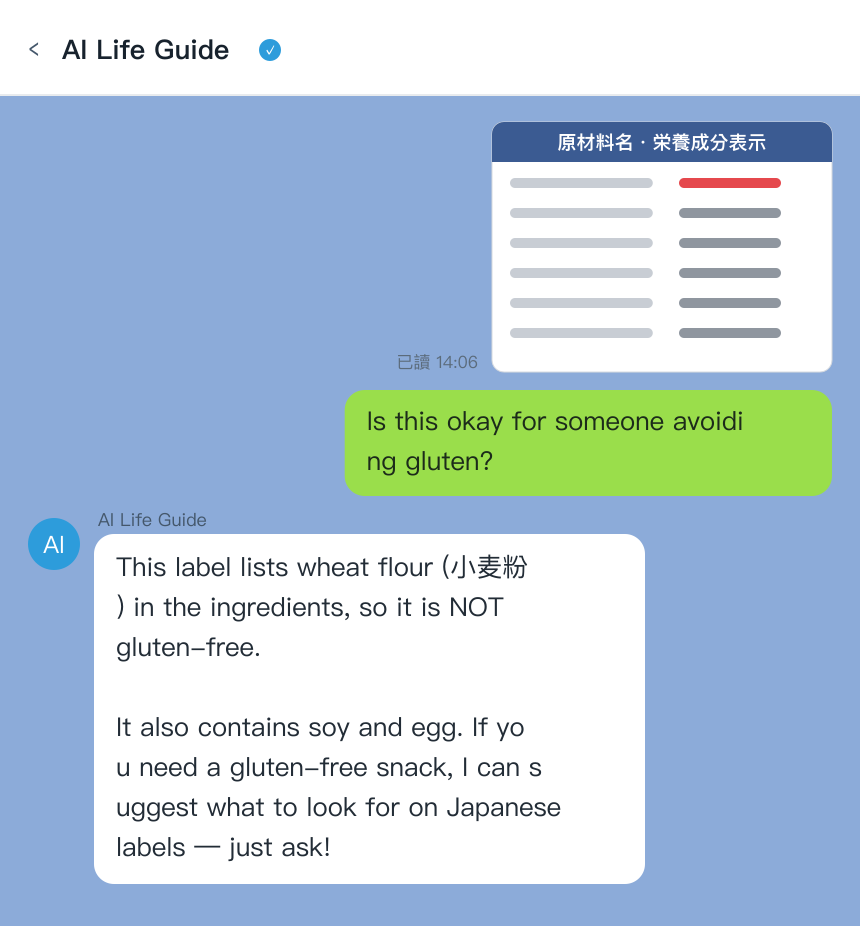
AI Life Guide demo: photograph a Japanese food label or ingredient list in LINE and ask about allergens in plain English (simulated screenshot)
The single most useful phrase to have ready, in Japanese or shown on your phone, is a version of "dashi wa haitte imasu ka" (does this contain dashi) — asking about dashi specifically, rather than asking a general "is this vegetarian," gets a far more useful answer, since staff may not think of fish stock as something that needs mentioning under a broader "vegetarian" question.
Halal strategy
Halal-certified restaurants genuinely exist in Tokyo, Osaka, and other major cities, and the number has grown steadily as tourism from Muslim-majority countries has increased. That said, certification is restaurant-by-restaurant, not a citywide or national standard, and a restaurant advertising "halal-friendly" isn't automatically the same thing as one carrying formal halal certification — the terms get used loosely enough that it's worth verifying directly with the restaurant rather than assuming from a sign or a menu icon.
The mirin-and-cooking-alcohol question from the hidden-ingredients section above matters especially here: a restaurant can be genuinely careful about pork while still using mirin or cooking sake as a standard seasoning unless it specifically markets itself as alcohol-free in preparation, not just alcohol-free on the drinks menu. Asking directly — "is alcohol used in the cooking, not just served as a drink" — is a more precise question than asking generally whether a dish is halal, and tends to get a more accurate answer.
Allergy strategy
Japan legally requires 8 specific allergens to be labeled on packaged food: shrimp, crab, walnut, wheat, buckwheat, egg, milk, and peanut. There's also a longer list of recommended-but-not-legally-mandatory allergens that manufacturers are encouraged, not required, to disclose — so the mandatory 8 is a useful baseline to know, not a complete picture of every ingredient worth worrying about.
That recommended (not mandatory) list is longer and covers items like soy, sesame, cashew, beef, pork, chicken, salmon, and gelatin — none of which a manufacturer is legally required to flag, so their absence from a label doesn't mean they're absent from the product. If you're managing an allergy outside the mandatory 8, that gap matters: a clean-looking label isn't the same as a verified ingredient list, and asking directly is still worth doing even when a package looks reassuring at a glance.
Restaurant menus are a different situation from packaged food: they aren't held to the same mandatory labeling standard, so a dish with a genuine allergen risk may simply have no label or warning at all. Printed allergy cards — a small card stating your allergy in Japanese, shown to kitchen staff before you order — remain one of the most reliable tools available, precisely because they put the question in front of a human who can check the actual recipe, rather than relying on a menu that was never required to disclose it.
A safety note worth taking seriously: any AI tool reading a label or menu from a photo — including AI Life Guide — is a first screen, not a guarantee. It can flag likely ingredients and known risk patterns, but it cannot see what happened in the kitchen, and it cannot rule out cross-contamination. For a serious or life-threatening allergy, always confirm directly with staff and carry a written allergy card as your primary safeguard, not a backup.
How AI Life Guide helps
Photograph a food label, a packaged snack's ingredient list, or a restaurant menu inside LINE, and AI Life Guide reads the whole image for context rather than translating it word by word — so instead of a literal, sometimes garbled ingredient list, you get a plain-English explanation of what's likely in a dish or product, and you can ask a direct follow-up: "does this contain fish stock," "is this cooked with alcohol," "does this have walnuts in it." That back-and-forth is the part a one-shot translation scan can't offer, and it's often the difference between guessing and actually understanding what you're about to eat.
The honest limit is the same one that applies to any photo-based tool: it can't see cross-contamination, kitchen practices, or substitutions that happened off-camera. Use it to narrow down what to ask about and to catch ingredients you might not have thought to check — then confirm anything that matters with a human, especially for allergies with a serious reaction risk.
Checking a label or menu before you eat? Add AI Life Guide on LINE (free) and photograph it before you order.
Guessing vs a translation app vs AI Life Guide + staff
- Approach: Guessing from appearance | Catches hidden dashi/alcohol: No | Explains ingredients: No | Safety for allergies: Not recommended | Cost: Free
- Approach: Translation app (word-for-word) | Catches hidden dashi/alcohol: Only if the word appears literally on the label | Explains ingredients: No | Safety for allergies: First screen at best | Cost: Free
- Approach: AI Life Guide + staff confirmation | Catches hidden dashi/alcohol: Yes, explains likely ingredients and flags risk | Explains ingredients: Yes | Safety for allergies: First screen — always confirm with staff for serious allergies | Cost: Free 5/day, $3.99/mo, $34.99/yr, $1.49 day pass
FAQ
Q: Is it hard to be vegetarian in Japan?
A: It's more manageable than its reputation suggests, but it does take some active checking — "vegetarian" on a menu often means no visible meat rather than no fish stock, so dashi in miso soup and simmered dishes is the main thing to watch for. Shojin ryori (temple cuisine) and reading convenience-store labels are two of the most reliable strategies, alongside asking about dashi directly rather than asking a general "is this vegetarian" question.
Q: Does miso soup contain fish?
A: Usually, yes — most miso soup is made with dashi that includes katsuobushi (bonito flakes), which makes it fish-based even though it looks and tastes nothing like a seafood dish. Kombu-only (kelp-based) miso soup without bonito does exist, particularly at shojin ryori restaurants, but it's the exception rather than the default, so it's worth asking if you need to avoid fish stock specifically.
Q: How do I say my allergy in Japanese?
A: A simple, direct pattern works well: name the allergen plus "ga taberaremasen" (I can't eat ___) or "arerugii ga arimasu" (I have an allergy to ___). Beyond the spoken phrase, a printed allergy card — stating your allergy clearly in Japanese and shown to kitchen staff before ordering — is one of the most reliable tools for anything serious, since it puts the question in front of a person who can check the actual recipe.
Q: Are there halal restaurants in Tokyo/Osaka?
A: Yes, and the number has grown steadily in both cities as well as other major tourist destinations. Certification is restaurant-by-restaurant rather than citywide, though, and "halal-friendly" isn't always the same thing as formally certified — verify directly with the restaurant, and ask specifically about cooking alcohol like mirin and sake, not just the drinks menu.
Q: Can AI apps detect allergens reliably?
A: Treat them as a first screen, not a guarantee. An AI tool reading a photo of a label or menu can flag likely ingredients and known risk patterns in plain English, which is genuinely useful for narrowing down what to ask about — but it can't see cross-contamination or kitchen practices. For a serious or life-threatening allergy, always confirm directly with staff and carry a written allergy card as your primary safeguard.
Bottom line
Eating safely in Japan as a vegetarian, halal-observant, or allergic traveler comes down to knowing where the hidden ingredients actually hide — dashi, cooking alcohol, and unlabeled restaurant menus — and having a fast way to ask a specific question instead of guessing from appearance. Use a tool that explains what's likely in a dish as a first screen, and back it up with a direct question to staff and a written allergy card whenever the stakes are real.
Before your next meal, add AI Life Guide on LINE (free) and photograph the label or menu you're unsure about.
Further reading
- How to Read a Japanese Menu in 2026: Ticket Machines, Handwritten Boards, and What Google Translate Gets Wrong
- Menu Translation Apps for Asia 2026: Order Confidently in Japan, Korea, Thailand & Taiwan
- Best Japan Travel Translation Apps 2026: 6 Tools Tested for Menus, Signs & Pharmacies
- The Thailand side of this guide: jay, halal, and hidden ingredients
Sources
- Japan's mandatory and recommended food allergen labeling standards, 2025-2026
- Hands-on travel testing, 2026