Ticket Machines, Call Buttons & QR Menus: How Ordering Actually Works in Japan (2026)
Reading a Japanese menu is only half the problem — the ordering process itself has its own unwritten rules, from ticket machines to call buttons to QR-only tables.
**Quick summary — 3-minute read**
• There's no single system — how you order in Japan changes restaurant to restaurant, and even a simple lunch can feel intimidating the first time.
• The ramen ticket machine (券売機) is the classic example: pay first at a vending-style machine, hand the printed ticket to staff, sit down.
• Call buttons, QR-only ordering, and the otoshi seat charge at izakaya are each a small unwritten rule, not a scam or a trick aimed at tourists.
• Japan Tourism Agency survey data: 54% of reported language-barrier trouble concentrates specifically in restaurants, and 12.3% of travelers report not knowing where to queue or how something works procedurally.
• AI Life Guide can read the machine, sign, or QR screen and explain which button or option to pick — but it can't press the button or hold your place in line for you.
Ordering food in Japan trips up far more first-time visitors than the food itself does. It's rarely about the menu being unreadable — plenty of restaurants have photos, and translation apps handle printed text reasonably well by now. It's the process: a ticket machine with unlabeled buttons, a call button nobody explained, a QR code that opens a page entirely in Japanese. Each restaurant format has its own small set of rules, and getting one wrong at the door is enough to make an ordinary lunch feel genuinely intimidating.
This guide walks through the formats that come up most often — ticket machines, call buttons, QR ordering, self-serve customs, conveyor sushi, izakaya etiquette, and the standing-only or counter-only variations — with what you'll actually see, what to do about it, and the one phrase that helps in each case.
1. The ramen ticket machine (券売機)
The ticket machine is the format most associated with Japan in traveler stories, and for good reason: it removes the waiter from the ordering process almost entirely. Near the entrance of many ramen shops, curry counters, and casual noodle restaurants stands a vending-style machine — a wall of buttons, sometimes with small photos, sometimes with Japanese text only, a coin slot and bill feeder, and a tray where a printed ticket drops out.
The mechanics are consistent even when the buttons aren't labeled in a language you read: you pay first, before you've even sat down, then press the button for your base dish, then any add-on buttons — 替玉 (kaedama, an extra serving of noodles added to the same broth once you've finished the first batch) and 大盛り (omori, a larger portion) are two of the most common. The machine prints a ticket, which you hand to staff on your way to a seat; they bring the dish without you ever having spoken a word of Japanese.
The confusion first-timers run into is real and specific: some machines are genuinely cash-only, which catches people off guard if they've been leaning on cards all trip, and older machines in particular tend to be Japanese-text-only with no photos at all, so there's nothing to visually match against a menu on the wall. Button order isn't alphabetical or logical to an outsider — it reflects how the shop itself categorizes its menu, not how a visitor would guess.
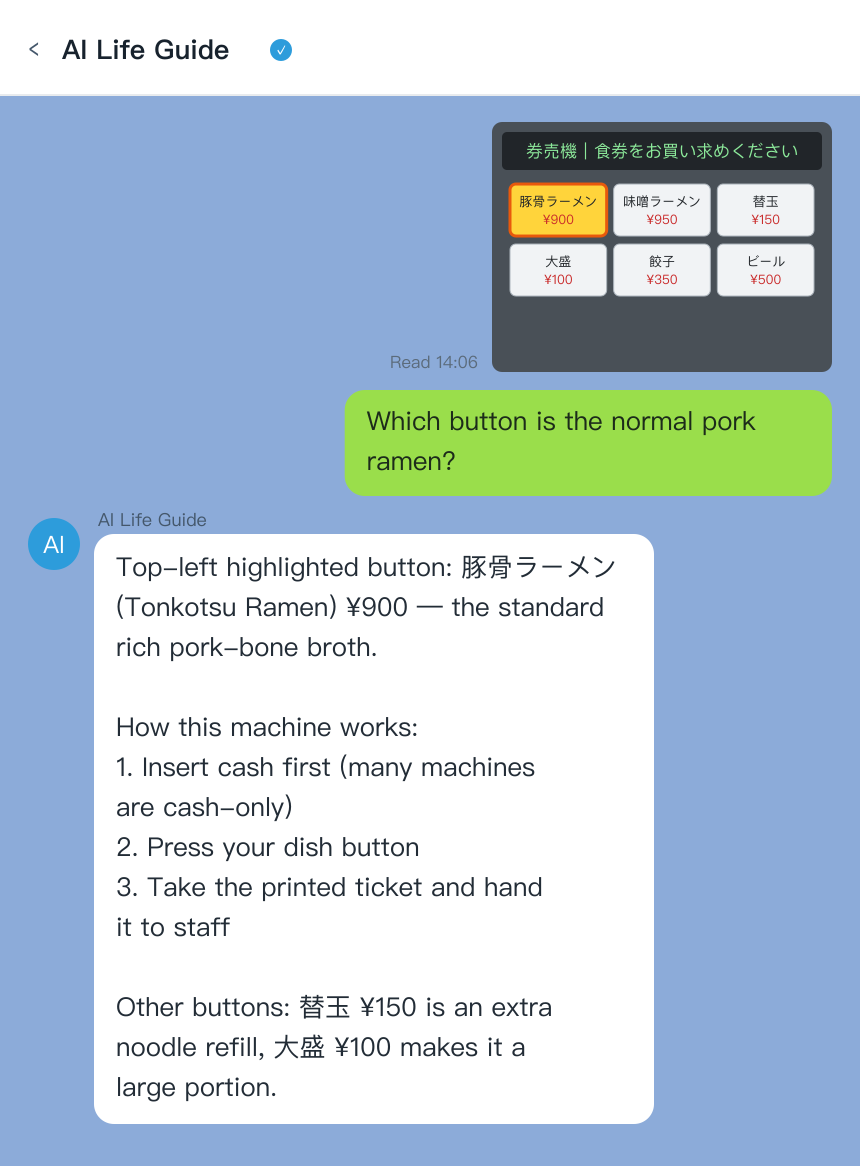
AI Life Guide demo: photograph a ramen ticket machine to find out which button matches which dish (simulated screenshot)
The phrase that helps: if a machine has no photos and you genuinely can't tell what a button says, it's completely normal to step aside, photograph the panel, and work out what each button means before you commit any cash — better than guessing and getting a dish, portion, or spice level you didn't want.
2. The call button (呼び出しボタン) vs. catching staff's eye
Many table-service restaurants in Japan have a small round button mounted on the wall or built into the table, often labeled 店員 (staff) or 呼び出し (call), that rings a chime at the counter when pressed. It's not rude to use it — it's the intended system, and staff generally wait to be called rather than circling tables the way servers do in much of the West.
Where no button exists, the equivalent is saying "sumimasen" (excuse me) clearly, once, rather than trying to catch a passing server's eye — eye contact and a raised eyebrow rarely work the way they might at home, since staff are often trained to approach only when addressed. A single clear "sumimasen" is the single most useful word in Japanese dining, and it works for ordering, requesting the check, or flagging a problem.
3. QR-code table ordering in Japanese-only interfaces
The newest trap in the ordering landscape is QR-code table ordering, which has spread fast across chain restaurants and a growing number of izakaya since the pandemic. A code printed on the table opens a menu in your phone's browser; you order and sometimes pay directly from your phone, and food arrives with no waiter interaction required at all — which sounds convenient until the interface turns out to be entirely in Japanese, with no visible language toggle.
Where this genuinely locks a visitor out is when the ordering system requires an account tied to a Japanese phone number or a LINE login you don't have — some QR-only izakaya have no staff-callable fallback at all, which is worth knowing before you sit down at one expecting to just ask a server instead. The workaround, when the system itself is usable but the language isn't, is the same as with a ticket machine: photograph the ordering screen and ask what a category or dish name means before you tap "confirm."
4. Self-serve water/tea, oshibori, and no tipping
A handful of customs are automatic rather than optional, and knowing they're normal — not a special favor or an oversight — avoids some awkward moments. Many casual restaurants provide water or unsweetened tea as self-serve, either from a pitcher at the table or an automatic dispenser; it isn't a paid item and isn't something you need to request.
A hot or cold wet towel (oshibori) is handed to you automatically at the start of most meals for wiping your hands before eating — it's not a napkin substitute and isn't billed. Tipping isn't customary in Japan and can genuinely confuse staff rather than being received as generosity; leaving extra cash on the table is more likely to prompt someone to chase you down to return it than to be understood as a tip.
5. Conveyor sushi + touchscreen
Kaiten-zushi (conveyor-belt sushi) has a simple original format — plates of sushi circulate on a belt, you take what looks good, and staff tally your bill at the end by plate color or count. Many newer and higher-volume chains have layered a touchscreen ordering system on top of, or instead of, the belt: you order specific items on a tablet at your seat, and they arrive on a separate high-speed track rather than the slow-circulating belt, which is sometimes largely decorative in these setups.
The two formats look similar from the outside but behave differently — some shops are pure grab-from-the-belt, some are touchscreen-order-only, and some mix both. Check the signage or ask before assuming you can just take a plate; if a touchscreen is Japanese-only, photographing it and asking what a category or button says works the same way it does at a ticket machine.
6. Izakaya: otoshi and ordering in rounds
Sitting down at many izakaya (casual Japanese pubs) brings a small dish to your table automatically within minutes — this is otoshi (お通し), a customary starter that functions something like a seating or cover charge rather than a dish you ordered. It genuinely surprises a lot of first-time visitors, and it's worth saying plainly: this is a longstanding custom at most izakaya, not a scam or an attempt to pad the bill, and it typically isn't something you can decline or send back.
Ordering itself tends to happen in rounds rather than all at once — instead of ordering starters, mains, and drinks together the way many Western restaurants expect, izakaya culture leans toward ordering a few shareable dishes, eating and drinking through them, then ordering more as the table wants. Getting a server's attention for another round works the same way as any other request: a clear "sumimasen" while raising a hand slightly.
7. Standing-only, counter-only, and ticket-then-queue variations
A few formats change the physical setup entirely. Tachinomi (standing bars) have no seats at all — you order and drink standing at a counter, which changes the pace and etiquette of a visit but not the basic ordering mechanics. Counter-only ramen and sushi shops seat everyone along a single line of stools facing the kitchen, generally with an expectation of faster turnover than a full table-service restaurant, especially when a line is forming outside.
One further variation combines the ticket machine with a queue: at some of the most popular ramen shops, you buy your ticket from the machine first, then join a line outside and wait for a seat to open before handing your ticket to staff — different from the more common ticket-then-immediate-seat flow. Watching what regulars in front of you do is usually the fastest way to figure out which variation you're dealing with.
- Format: Ticket machine ramen | How you order: Buy a ticket, hand it to staff | How you pay: Upfront, often cash-only
- Format: Table service | How you order: Call button or "sumimasen" | How you pay: After the meal, register or table
- Format: QR table ordering | How you order: Phone browser, no waiter needed | How you pay: Via phone or at the register
- Format: Conveyor sushi | How you order: Take plates or touchscreen order | How you pay: Plates or screen order tallied at the end
- Format: Standing bar (tachinomi) | How you order: Order at the counter | How you pay: As you go or at the end
Standing in front of a ticket machine or QR screen you can't read? Add AI Life Guide on LINE (free) and photograph it for a plain-English read of what to press.
FAQ
Q: How do ramen ticket machines work?
A: You pay first at the machine — often cash — pressing a button for your base dish and any add-ons like extra noodles (kaedama) or a larger portion (omori). The machine prints a ticket, which you hand to staff when you sit down, and they bring the dish without any further ordering conversation needed.
Q: Is the otoshi charge a scam?
A: No — otoshi is a longstanding custom at most izakaya, functioning like a seating or cover charge, and it's automatic rather than something you ordered or can send back. It surprises many first-time visitors because nothing on a Western-style menu prepares you for a dish arriving before you've ordered anything.
Q: How do I call the server in a Japanese restaurant?
A: Press the call button if the table has one — usually a round button labeled 呼び出し or 店員 — or say "sumimasen" (excuse me) clearly once. Staff generally wait to be addressed rather than circling tables, so a raised eyebrow or eye contact often doesn't work the way it might at home.
Q: Do I tip in Japan?
A: No — tipping isn't customary and can genuinely confuse staff rather than being appreciated as generosity. Leaving extra cash on the table is more likely to prompt someone to chase after you to return it than to be understood as a tip.
Q: What if the QR menu is only in Japanese?
A: Photograph the ordering screen and ask what a category or dish name means before you order — this works the same way as reading a ticket machine. Be aware some QR-only restaurants genuinely have no staff-callable fallback, so it's worth checking the interface is usable at all before you sit down expecting to just ask a server instead.
Bottom line
None of these formats are designed to exclude visitors — they're just built for a domestic audience first, with English support layered on unevenly depending on the restaurant. Once you've seen a ticket machine, a call button, and an otoshi dish once each, the pattern stops feeling like a test and starts feeling like a normal part of eating in Japan.
Heading to a restaurant format you've never navigated before? Add AI Life Guide on LINE (free) and photograph the machine, sign, or screen before you commit.
Further reading
- How to Read a Japanese Menu Without Speaking Japanese
- How to Book a Restaurant in Japan Without Speaking Japanese (2026)
- Cash or Card in Japan 2026: Where You Still Need Yen, IC Cards, and ATMs That Take Foreign Cards
Sources
- Japan Tourism Agency traveler survey, 2024–2025
- Hands-on testing and traveler forum reports, 2026