Getting Sick in Japan: Buying the Right Medicine at a Drugstore (2026)
Most trips to Japan never need this — but when you do get sick, don't expect fluent English at the counter. Here's how to actually read what's on the box.
**Quick summary — 3-minute read**
• This is a low-frequency but high-intensity problem: most trips to Japan never need a drugstore, but getting sick away from home is stressful precisely because nothing about the system is familiar.
• Don't expect fluent English medical consultations — pharmacists and clinic staff often rely on printed English phrase sheets rather than spoken fluency.
• Japan's over-the-counter classification system means some medicines legally require a pharmacist's direct involvement to sell, not just a self-checkout purchase.
• The common traveler workaround — photographing the box and reading the translation — genuinely works as a first screen for identifying what a medicine treats.
• This is label comprehension, not medical advice: dosage decisions, drug interactions, and anything serious belong with a pharmacist or doctor, not a translation tool.
Getting sick in Japan is, for most travelers, something that simply never happens on a given trip — this isn't a high-frequency problem the way a confusing menu or a language barrier at a restaurant is. But when it does happen, it tends to land hard: you're not fluent, the person behind the counter often isn't either, and you're trying to make a health decision under time pressure in an unfamiliar system.
This guide covers how Japanese drugstores are actually organized, how to identify common medicine categories from the packaging, when a drugstore genuinely isn't enough and you need a clinic, and how to use a photo-and-translate approach responsibly — as a way to understand what's on a label, not as a substitute for professional advice.
The drugstore landscape
Large drugstore chains are common near train stations and in shopping districts in most Japanese cities, generally easy to spot from the street and stocked with a wide range of over-the-counter medicine, cosmetics, and daily goods. What surprises a lot of visitors is Japan's tiered classification system for non-prescription medicine: certain categories, generally the most powerful over-the-counter drugs, legally require a pharmacist to be involved in the sale — sometimes meaning a short form to fill out, sometimes meaning you simply can't self-checkout with the item and need to speak with staff directly, even briefly.
It's worth setting expectations honestly here: don't assume fluent English medical consultation is available, even at large chains in major cities. Pharmacists and drugstore staff frequently rely on printed English-language phrase sheets or pointing charts to communicate with foreign customers rather than speaking English fluently themselves, and that's a completely normal, functional system — it just means the conversation may move slower and rely more on gestures and written words than you're used to.
Common OTC categories and how to identify them by package
Japanese medicine packaging generally groups by symptom rather than by brand recognition a foreign visitor would know, so learning to recognize a few categories by their typical packaging and printed Japanese terms is more useful than looking for a familiar logo.
- Cold and fever relief (風邪薬, kaze-gusuri): usually boxed with imagery suggesting cold symptoms — a person with a scarf, a thermometer icon, or similar — and often sold as a multi-symptom combination product.
- Pain relievers (鎮痛剤, chintsuuzai): typically simple boxes focused on headache or general pain relief, often the most straightforward category to identify visually.
- Stomach medicine (胃腸薬, ichouyaku): covers a range from general stomach upset to more specific digestive complaints — worth asking staff to help narrow down rather than guessing, since the category is broad.
- Allergy medicine (アレルギー薬 / 花粉症, kafunshou for hay fever specifically): widely stocked given Japan's seasonal pollen issues, generally easy to find but worth confirming the active ingredient matches what you'd normally take.
- Motion sickness (乗り物酔い薬, norimonoyoi-gusuri): a smaller, specific category, often near the travel-goods section of a drugstore rather than the general medicine aisle.
Useful printed terms to look for on any box, regardless of category, include 用法・用量 (dosage and directions for use), 効能・効果 (indications, meaning what the product treats), and 使用上の注意 (precautions or warnings). Recognizing these headers helps you find the relevant section of a label even before translating the full text.
An honest limit worth stating clearly: this guide describes categories and how to identify them, not specific dosages, and it's not making a claim that any Japanese product is equivalent to a specific medicine you take at home. Confirming an equivalent product and correct dosage with a pharmacist is a step worth taking, not skipping, especially if you take other medication or have an existing condition.
Before you get sick: a few minutes of prep that pays off
A short amount of preparation before you ever feel unwell makes the whole situation easier if it happens. Knowing the generic active ingredient name of your regular medications — not just the brand name you buy at home — helps a pharmacist or a translation tool identify a genuine equivalent, since Japanese OTC products are rarely sold under the same brand names you'd recognize. Photographing your own prescription labels or packaging before you travel gives you something concrete to show a pharmacist or doctor if you do need care, rather than trying to describe a medication from memory.
It's also worth learning a small set of symptom words in advance, or keeping them saved on your phone, since describing symptoms precisely — fever, sore throat, stomach pain, nausea — helps narrow down which drugstore category or clinic visit actually applies. A basic travel first-aid kit from home, covering the mildest, most predictable issues, reduces how often you need to solve this problem locally at all.
When a drugstore isn't enough: clinics and the walk-in reality
For anything beyond what an over-the-counter product can reasonably address, the next step is a clinic. English-speaking availability varies significantly by clinic and by city, and walk-in acceptance varies too — some clinics operate with an appointment-heavy culture even for same-day visits, which can mean arriving early in the day's opening hours improves your odds of being seen rather than simply showing up whenever symptoms hit.
If you have travel insurance, contacting your provider's assistance line before or as soon as possible after seeking care is worth doing where circumstances allow — many policies require notification within a certain window or maintain a network of partner clinics that simplifies both the visit and the claim afterward. Japan also maintains a multilingual tourist information hotline intended partly for exactly this kind of situation — a starting point for guidance in English when you're not sure where to go, worth looking up before your trip so you have it on hand if you need it.
Bringing your own medication into Japan
Japan has import rules for certain medications, including quantity limits and restrictions on some substances that are legal in other countries — the specifics change and are genuinely worth checking against official government guidance (your embassy's travel advisory or Japan's Ministry of Health resources) before you travel, rather than relying on secondhand summaries. As a general practice, carrying medication in its original packaging, along with a doctor's note or prescription documentation where relevant, makes any conversation with customs or a pharmacist considerably more straightforward.
How to read a Japanese medicine box
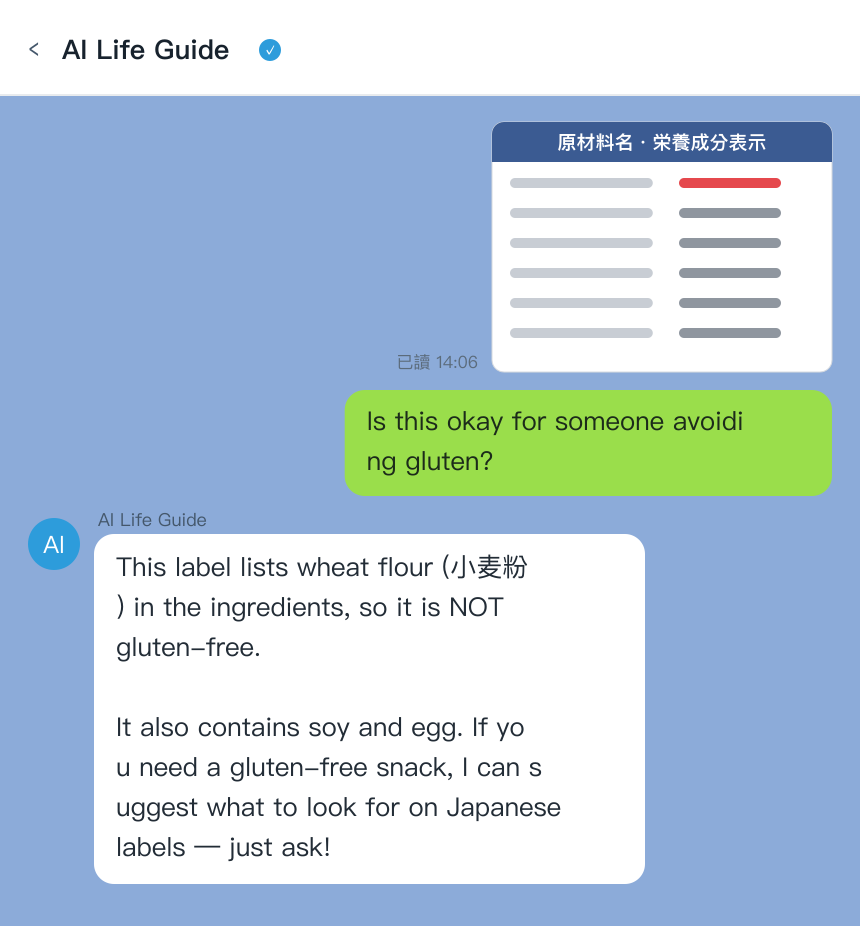
AI Life Guide demo: photograph a medicine box to identify what it treats, active ingredients, and dosage instructions (simulated screenshot)
Photographing a medicine box and asking what it treats, what the active ingredients are, and what the dosage instructions and warnings say is a genuinely useful first screen — it turns a wall of unfamiliar Japanese text into a plain-English summary you can act on or bring to a pharmacist for confirmation. The honest limit is just as important as the usefulness: this reads a label, it does not diagnose your symptoms, and it can't tell you whether a given product is the right choice for your specific situation, especially if you're managing an allergy, taking other medication, or dealing with anything beyond a straightforward, short-term complaint.
- Category: Cold/fever (風邪薬) | Look for: Cold-symptom imagery, multi-symptom combination products
- Category: Pain relief (鎮痛剤) | Look for: Simple packaging focused on headache/general pain
- Category: Stomach (胃腸薬) | Look for: Broad category — ask staff to help narrow it down
- Category: Allergy/hay fever (花粉症) | Look for: Widely stocked seasonally; confirm active ingredient
- Category: Motion sickness (乗り物酔い薬) | Look for: Smaller section, often near travel goods
Staring at a medicine box you can't read? Add AI Life Guide on LINE (free) and photograph it for a plain-English read of what it treats.
FAQ
Q: Can I buy cold medicine in Japan without a prescription?
A: Yes — cold and fever medicine, pain relievers, and several other categories are available over the counter at drugstores throughout Japan. Some of the stronger OTC categories legally require a pharmacist to be involved in the sale, which can mean a short form or a brief conversation before you can buy it.
Q: Do Japanese pharmacists speak English?
A: Not reliably — don't expect fluent English medical consultation, even at large drugstore chains in major cities. Many pharmacists and staff use printed English phrase sheets or pointing charts to communicate rather than speaking fluently, which works but moves more slowly than a native-language conversation.
Q: What do I do if I need a doctor in Japan?
A: Look for a clinic, keeping in mind that English-speaking availability and walk-in acceptance both vary by location — arriving early in a clinic's opening hours often improves your odds of being seen same-day. Contact your travel insurance provider's assistance line as soon as you reasonably can, and consider Japan's multilingual tourist information hotline as a starting point if you're unsure where to go.
Q: Can I bring my own medication into Japan?
A: Generally yes, but Japan has import rules including quantity limits and restrictions on certain substances that are legal elsewhere — check official guidance from your embassy or Japan's Ministry of Health before you travel rather than assuming your medication is unrestricted. Carrying medication in original packaging with a prescription or doctor's note makes any customs or pharmacy conversation considerably easier.
Q: How do I read a Japanese medicine box?
A: Look for the printed headers 効能・効果 (what it treats), 用法・用量 (dosage and directions), and 使用上の注意 (warnings) to find the relevant sections of the label. Photographing the box and asking for a plain-English translation works as a useful first screen — but it explains the label, it doesn't diagnose your symptoms or replace a pharmacist's advice.
Bottom line
Most trips to Japan won't need any of this — but if you do get sick, the combination of an unfamiliar drugstore system and a genuine language gap can turn a minor cold into a stressful afternoon. Knowing the classification system exists, recognizing a handful of category labels, and treating a photo-and-translate tool as a first screen rather than a diagnosis covers most of what a traveler actually needs.
Not feeling well and staring at an unfamiliar drugstore shelf? Add AI Life Guide on LINE (free) and photograph the box before you buy.
Further reading
- 10 Apps to Download Before Your Japan Trip (2026) — And the One Hiding Inside LINE
- Cash or Card in Japan 2026: Where You Still Need Yen, IC Cards, and ATMs That Take Foreign Cards
- Vegetarian, Halal, or Allergic in Japan: How to Check What's Really in Your Food (2026)
Sources
- Japan Tourism Agency traveler survey, 2024–2025
- Hands-on testing and traveler forum reports, 2026
- General public guidance referenced from Japan's tourist information services