Traveling Taiwan Without Reading Chinese (2026): Night Markets, Bento Counters, Ticket Gates and the Receipt Lottery
English carries you through Taiwan’s airports, metros and highway signs, then disappears at the handwritten stall sign in front of you — here is what those signs, buffet counters, ticket gates and receipts actually say.
**Quick summary — 3-minute read**
• Taiwan’s language gap has an odd shape: the infrastructure is bilingual, the stall in front of you is not.
• Night markets run on three ordering systems — point-and-count, a tick-box paper slip, and load-your-own basket.
• Self-serve buffets (自助餐) price your plate after you fill it, by weight or by eye. 內用 (eat in) and 外帶 (take away) are the two most useful characters in the country.
• 素食 (vegetarian) here usually excludes onion and garlic too; packaged food carries one of five legally defined labels.
• Your receipt is a lottery ticket: every 統一發票 has an eight-digit number drawn on the 25th of odd-numbered months, and visitors can claim with a passport.
• AI Life Guide reads handwritten signs, medicine boxes and ticket screens inside LINE — free for 5 messages a day. For allergies and medication it is a first read, not a clearance.
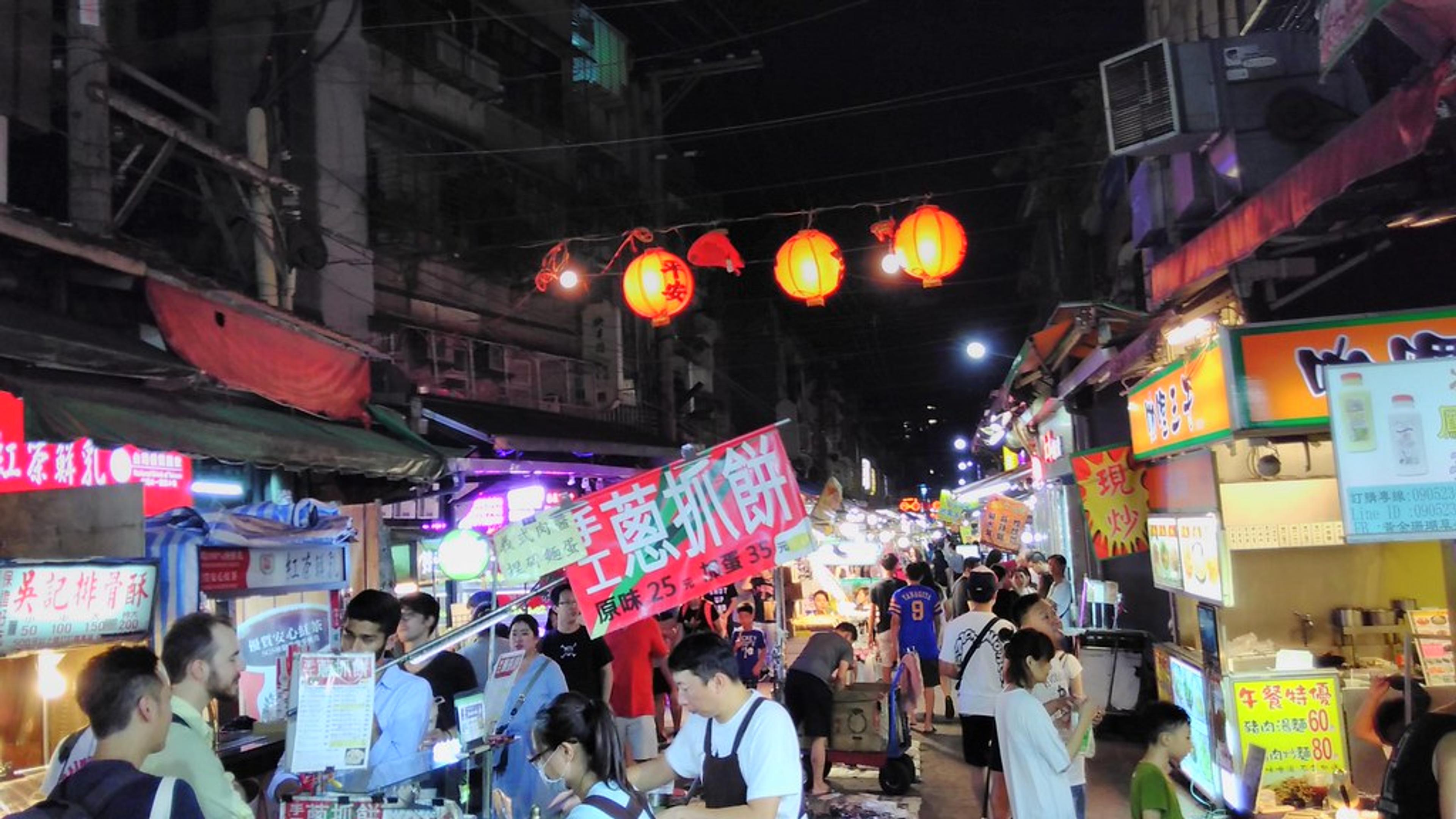
Taiwan is regularly called one of the easiest places in Asia to travel without the local language, and that is true right up to the moment it suddenly is not. The metro, the high-speed rail and the museum captions are all bilingual and all good. Then it is nine at night, you are in front of a night market cart, and the whole menu is eight items in marker pen with a queue building behind you.
That second layer — handwritten, local, unbothered about whether you can read it — is what this guide covers: what the signs say, how ordering works, which ticket you need, what you can buy at a pharmacy, and the thing nobody warns visitors about, which is that the receipt you are about to bin is a lottery ticket. Where a number would go stale, we say how to check it rather than quoting a figure that will be wrong by the time you travel.
1. The gap is not where you expect it
Picture Taiwan’s English coverage as two layers built by different people. The infrastructure layer — airports, metros, high-speed rail, national parks, big museums, chain retail — is deliberately bilingual and genuinely good; you can run a whole itinerary on it without needing a character. The human layer — the family noodle shop, the night market cart, the neighbourhood pharmacy, the buffet counter, the notice taped to a door — was never built for you and usually carries no English at all. The food worth remembering lives on the second layer.
Two structural quirks help. Romanization is inconsistent: Taiwan has cycled through several systems, so the same place appears as Tamsui or Danshui, Keelung or Jilong, and a map and a station sign can disagree without either being wrong — screenshot the characters instead of trusting a spelling. And addresses read outside-in, using 號 (number), 弄 (alley), 巷 (lane), 段 (section), 路 (road) and 街 (street); lanes and alleys are real, narrow branches off the main road, which is why a taxi drops you on the main road and expects you to walk in.
2. Night markets: the sign is handwritten and there is no menu
Night market stalls mostly do not do printed menus. A specialist cart sells one thing; a bigger stall lists six to ten items in marker pen; some list nothing and simply display what they have. Nearly all ordering falls into three systems, and recognising which one you are in shrinks the problem to almost nothing.
- Point and count. Skewers, sausages, fruit, pancakes — anything visible. Point, hold up fingers for quantity, hear the price. Small notes in hand removes the last bit of friction.
- The tick-box slip. Standard at noodle shops, dumpling houses and stir-fry places. You get a paper menu with a narrow column beside each item, write a number in the column, and hand the slip back. Nobody expects you to say anything.
- Load your own basket. At 鹹酥雞 (fried snacks) and 滷味 (braised snacks) stalls you take a basket and tongs, load raw items from the display yourself, and hand it over to be cooked and priced by what you picked. You will be asked about chilli, and at fried-snack stalls whether you want 九層塔 (Thai basil) in the fryer. Say yes to the basil.
Portion size is its own vocabulary. 小份 (small) and 大份 (large) are often the only price distinction on the board, and 一份 means one serving. If you are grazing your way down a market — the correct way to do one — 小份 is nearly always right, and ordering 大份 at the first stall is the classic first-night mistake.
Dishes that are not what they look like:
- 豬血糕 — pig’s blood rice cake on a stick, rolled in peanut powder and coriander. Reads as a chocolate ice pop from three metres away. It is not one.
- 大腸包小腸 — "big sausage wraps small sausage": a split grilled glutinous rice sausage used as the bun around a pork sausage.
- 蚵仔煎 — oyster omelette bound with sweet potato starch. The gelatinous texture is the dish working correctly.
- 大腸麵線 — thin noodles in a thick broth, with either pig intestine (大腸) or oysters (蚵仔). In the pot they look identical; the sign is the only tell.
- 臭豆腐 — deep-fried with pickled cabbage is the gentle introduction; simmered in a spicy or fermented broth is considerably more assertive.
Two questions come up everywhere. Chilli runs 不辣 (none), 小辣 (mild), 中辣 (medium), 大辣 (hot) — and 麻, the numbing tingle of Sichuan peppercorn, is a separate axis from 辣. Drink shops ask about sugar (無糖/微糖/半糖/少糖/全糖) and ice (去冰/微冰/少冰/正常冰); full sugar is sweeter than most visitors expect, so 半糖 is a safe first order.
Standing in front of a handwritten stall sign right now? Add AI Life Guide on LINE (free) and photograph it for a plain-English read of what the stall sells.
3. Bento shops and self-serve buffets
Two lunch institutions dominate everyday eating and work in opposite ways. A 便當 shop is the simple one: the sign lists the mains — 排骨 (fried pork chop), 雞腿 (chicken leg), 魚 (fish), 焢肉 (braised pork belly) — and you pick exactly one. Rice and three or four sides come with it, chosen by the shop and different every day, which is why the price list looks suspiciously short.
A 自助餐 (self-serve buffet) is where visitors get uneasy, because it is not all-you-can-eat and the price is worked out after you serve yourself. You fill a plate from twenty-odd trays of home-style dishes and hand it to the cashier, who either weighs it (秤重) or judges it by eye, counting meat dishes against vegetable ones. Both are normal; the uncertainty is simply how the format works.
Read the laminated price notice near the trays before you start, since it says whether the shop weighs or counts. Keep meat dishes to one or two and load up on vegetables. And glance at the plate of the person ahead of you — portion norms here are smaller than a Western buffet instinct suggests.
One question gets asked at every counter in the country: 內用 or 外帶 — eating in, or taking away. Take-away gets bagged, and because single-use bags are regulated you may be charged for a bag or asked whether you want one at all; dining in usually means proper crockery and sometimes a different queue.
4. Convenience stores: the counter, the pot and the kiosk
The hot counter is the main event. 關東煮 (oden) sits in a divided vat of broth — at many stores you serve yourself with tongs and the cashier counts the skewers, at others you point and staff plate it. 茶葉蛋 (tea eggs) simmer in a small pot by the till. Chilled bentos and buns can be microwaved; the word is 加熱. Expect three quick questions at the register that sound alike if you do not know them: whether you want it heated, whether you need utensils (餐具), and whether you want a bag (袋子) — the last is genuine rather than a formality, because bags are chargeable.
Two counter services matter. Topping up a stored-value card means handing over the card and cash with the word 加值, in practice a cash transaction. And convenience stores act as a national bill-payment desk (代收), settling utility bills, fines and online-order payments from a barcode slip. The in-store kiosk — ibon at 7-Eleven, FamiPort at FamilyMart and equivalents elsewhere — prints tickets, handles parcels and prints invoice prize slips through a menu tree that is largely Chinese-only. If one screen in Taiwan is worth photographing rather than tapping hopefully, it is that one.
5. Trains, metros and buses: which ticket, which card
A stored-value card is the best first purchase of a Taiwan trip. EasyCard (悠遊卡) and iPass (一卡通) both cover metro systems, city buses, convenience stores and a long list of shops; buy either at a convenience store or metro station and top it up with cash. Which one you get matters far less than having one.
Metros are the easy part. Single journeys are sold as a plastic token you tap going in and drop into a slot on the way out, but a card is faster and earns transfer discounts. Exits are numbered rather than named by direction — 出口 1, 出口 2 — a relief compared with Japan. One rule catches tourists: eating and drinking inside the paid area of the Taipei metro is prohibited and enforced with fines, water included.
The conventional railway and the high-speed rail are different systems with different rules, and conflating them is the most common ticketing mistake visitors make.
- Taiwan Railway: local and commuter services (區間車) have no reservations and accept stored-value cards — tap in, tap out, sit anywhere. Reserved services are ticketed, certain premium train types are excluded from card use, and tapping onto a reserved train does not assign you a seat. If a seat matters, buy a ticket.
- High-speed rail: a separate company with separate ticketing. A plain tourist EasyCard will not open HSR gates — tap-to-ride there is limited to particular co-branded credit cards issued to residents. Buy a ticket and choose 對號座 (reserved) or 自由座 (non-reserved, in specific cars).
- City buses: a display near the driver shows 上車收費 (pay on boarding) or 下車收費 (pay on alighting), and it can switch mid-route as the bus crosses a fare section. Regular riders simply tap on the way in and again on the way out, which covers both cases.
Fares, discounts and card acceptance all change. The mechanisms above are stable; the numbers attached to them are not, so verify any figure at the counter or on the posted fare chart.
6. The receipt is a lottery ticket
Taiwan runs a national receipt lottery to push businesses into issuing proper tax receipts, so every legitimate purchase produces a 統一發票 (uniform invoice) carrying an eight-digit number entered into a public draw. The slip from a bottle of tea is, in a small and real way, a lottery ticket — which is why locals keep receipts that look worthless.
The draw runs on the 25th of every odd-numbered month — January, March, May, July, September, November — and covers the two months before it. Matching all eight digits is the top tier; lower tiers match progressively fewer trailing digits, with the smallest prize needing only the final three to line up. That bottom tier is common enough that checking a fistful of receipts is ordinary behaviour rather than a fantasy.
Foreign visitors can claim. The claim period opens the month after the draw and runs roughly three months; the smallest prizes are redeemed over the counter at convenience stores and larger ones at designated banks, where a passport is the identification a visitor presents. Prize amounts and the exact window are set by regulation and adjusted periodically, so check the Ministry of Finance’s current announcement rather than a number in an article.
One trap quietly disqualifies most tourist receipts. Cashiers often ask whether you want the invoice on a 載具 — a digital carrier, stored against a barcode in a Taiwanese app you almost certainly do not have. Say yes without understanding the question and the slip you get is a 銷貨明細 (sales detail), which is not the invoice and cannot be redeemed. Decline the carrier and keep the printed slip with the eight-digit number.
- Many registers also have a donation box for receipts — dropping yours in donates any winnings to charity. A good default, but know that is what you are doing rather than assuming it is a bin.
7. Pharmacies and clinics: what you can just buy
Three kinds of shop look similar from the street and are not interchangeable. A 藥局 is a pharmacy with a licensed pharmacist on duty. A 藥妝店 is a drugstore chain — cosmetics, toiletries and a much narrower medicine range. A 診所 is a clinic with a doctor, usually walk-in and usually fast.
Taiwan sorts medicines into three tiers, and knowing them tells you which shop you need. 處方藥 is prescription-only. 指示藥 needs no prescription but is meant to be bought from a pharmacy with a pharmacist to guide it, and is often kept behind the counter. 成藥 is general over-the-counter, split again into a class restricted to pharmacies and a milder class sold in convenience stores. Everyday painkillers, cold remedies and stomach medicines are obtainable without a doctor — but which shop you are standing in decides what is on the shelf.
The necessary caveat: an AI reads and explains what is printed on the box — classification label, active ingredients, dosage, warnings. It is not a pharmacist and cannot account for your medical history, your other medications, or a condition it does not know about. Use it to understand what you are holding, then ask the pharmacist or see a doctor for anything beyond a headache.
If you do need a clinic, walk-in 診所 are everywhere and visits are quick. National Health Insurance does not cover short-term visitors, so you pay out of pocket — and before leaving, ask for a 診斷證明書 (medical certificate) and an itemised 收據 (receipt). Travel insurers want both, and getting them after you have flown home is far harder than asking at the desk.
8. Vegetarian, vegan and the five pungent roots
Taiwan is one of the easiest places in Asia to eat vegetarian, structurally rather than as a trend: a large Buddhist vegetarian population means 素食 restaurants and vegetarian buffets in almost every neighbourhood. They are often marked with a green 卍 — a Buddhist auspicious symbol that long predates and has nothing to do with its twentieth-century European misuse. On a Taiwanese shopfront it means vegetarian food served here.
The nuance runs in an unexpected direction: Taiwanese Buddhist vegetarianism also excludes the 五辛, the five pungent roots — onion, garlic, chives, shallot-family alliums and asafoetida. Packaged food therefore carries one of five defined labels.
- Label: 全素 / 純素 | Means: Pure plant-based and free of the five pungent roots — the strictest tier
- Label: 蛋素 | Means: As above, plus egg
- Label: 奶素 | Means: As above, plus dairy
- Label: 奶蛋素 | Means: As above, plus both egg and dairy
- Label: 植物五辛素 | Means: Plant-based but may contain onion, garlic and other alliums
Read practically: vegans want 全素 or 純素. If you are vegetarian and happy with garlic, 植物五辛素 makes life easier and holding out for 全素 is stricter than you need. If you eat eggs and dairy, 奶蛋素 opens up a lot of bakery and convenience-store food.
At ordinary restaurants the risk runs the other way, and it is about what the dish was cooked in rather than what is visible on the plate. 高湯 (stock) is commonly pork- or chicken-based; 豬油 (lard) is a normal frying fat; 蠔油 (oyster sauce) and 魚露 (fish sauce) turn up in stir-fried greens; 柴魚 (dried bonito) appears in sauces. A plate of vegetables is not automatically vegetarian.
The necessary caveat again: packaged food carries allergen labelling under Taiwan’s food rules, but a night market cart carries no label and shares fryers and woks freely. An AI can read a label and explain it; it cannot inspect the kitchen. For a serious allergy, a written card in Chinese stating exactly what you cannot eat, handed over and confirmed verbally, is still the most reliable thing you can carry.
9. Characters worth recognising on sight
Recognising these on a sign or a screen removes most of the day-to-day friction by itself.
- 內用: Eat in | 外帶: Take away
- 小份: Small portion | 大份: Large portion
- 不辣: Not spicy | 小辣 / 大辣: Mild / hot
- 素食: Vegetarian | 全素: No egg, dairy or the five pungent roots
- 加熱: Please heat this up | 餐具: Utensils
- 加值: Top up a stored-value card | 袋子: Bag — usually chargeable
- 秤重: Priced by weight | 只收現金: Cash only
- 售完 / 完售: Sold out | 公休: Regular closing day — not shut down, just their day off
- 統一發票: Uniform invoice — receipt and lottery ticket | 載具: Digital carrier — decline it to keep the claimable paper slip
- 上車收費: Bus: pay on boarding | 下車收費: Bus: pay on alighting
- 出口: Exit | 藥局: Pharmacy with a pharmacist on duty
10. Where AI Life Guide fits — and where it does not
The honest description is narrow: inside LINE, you photograph the thing you cannot read — the handwritten stall board, the buffet price notice, the medicine box, the ibon screen — and get it explained in English, with follow-up questions allowed. "Is this pork?" "Which of these is the small portion?" It is a reading aid for the human layer described at the top of this article, not a route planner or a booking tool.
Taiwan is the one market where "it is already in your chat app" needs no explaining, because LINE is the default messaging app here — guesthouses, drivers and small shops hand out a LINE ID the way businesses elsewhere hand out a phone number. The honest version: if you already use LINE, this is not another app or another account. If you do not, it is one install — but it is the install that also gets you talking to your accommodation.
The free tier covers 5 messages a day, enough for a couple of menus and a sign. Beyond that it is $3.99 a month, $34.99 a year, or a $1.49 day pass — the day pass being the sensible option for a single night-market crawl.
The limits, stated plainly:
- It needs a data connection — sort out a SIM or eSIM at the airport, because there is no offline mode.
- It reads what is printed and visible. A stall with no sign at all is beyond any photo-based tool.
- It cannot act for you: it will not order your food, buy your ticket, or ask the cook what is in the wok.
- For allergies and medication it is a first read, not a clearance.
FAQ
Q: Can you get by in Taiwan without speaking Chinese?
A: Yes, for the great majority of a trip. Airports, metro systems, high-speed rail, major museums and chain stores are signed in English, and staff in tourist-facing businesses usually meet you halfway. The gap shows up at family-run eateries, night market stalls, self-serve buffets, neighbourhood pharmacies and anything handwritten — solvable by pointing, by photographing the sign to get it read back, and by recognising a dozen characters like 內用 (eat in) and 小份 (small portion).
Q: Do I need cash in Taiwan?
A: Yes — carry cash even though Taiwan is well covered by cards. Convenience stores, chains and mid-range restaurants take cards, but night market stalls, small family eateries, traditional markets and temples are frequently cash-only. A stored-value card (EasyCard or iPass) covers metros, buses and convenience stores and is topped up with cash. Local mobile payment apps generally require a Taiwanese bank account or phone number, so they are not an option for most short-term visitors.
Q: What is the Taiwan receipt lottery, and can tourists claim a prize?
A: Every legitimate receipt in Taiwan is a 統一發票 (uniform invoice) carrying an eight-digit number entered into a national lottery, drawn on the 25th of odd-numbered months and covering the previous two months. Foreign visitors can claim using a passport — the smallest prizes at convenience stores, larger ones at designated banks — within a claim period that opens the month after the draw. Keep the printed slip and decline the digital carrier (載具), because a carrier receipt prints as a 銷貨明細 sales detail that cannot be redeemed.
Q: How do you order at a Taiwanese night market if you cannot read the sign?
A: Three systems cover nearly everything. At most stalls you point at what is displayed and hold up fingers for quantity. At noodle and stir-fry shops you are handed a paper slip and write a number beside each item you want. At fried-snack and braised-snack stalls you take a basket and tongs, load raw ingredients yourself, and hand it over to be cooked and priced by what you picked. Portions are offered as 小份 (small) or 大份 (large), and 不辣 means not spicy.
Q: Can I buy medicine in Taiwan without a prescription?
A: Many everyday medicines, yes. Taiwan classifies drugs into prescription-only (處方藥), pharmacist-guided (指示藥) and general over-the-counter (成藥); the latter two need no doctor, though pharmacist-guided items must come from a 藥局 pharmacy with a pharmacist on duty rather than a cosmetics-style drugstore. Anything ongoing or prescription-based means a clinic visit, which walk-in 診所 handle quickly and at your own expense, since National Health Insurance does not cover short-term visitors.
Q: Does vegetarian in Taiwan mean the same thing as it does at home?
A: Not exactly. Taiwanese 素食 generally follows Buddhist practice and also excludes the five pungent roots — onion, garlic, chives, shallots and asafoetida — so it is often stricter than Western vegetarianism. Packaged food uses five defined labels: 全素/純素 (pure plant), 蛋素 (with egg), 奶素 (with dairy), 奶蛋素 (with both) and 植物五辛素 (plant-based but may contain alliums). At non-vegetarian restaurants the risk is the opposite: pork stock, lard, oyster sauce and dried bonito appear in dishes that look plant-based.
Bottom line
Taiwan is genuinely easy to travel and genuinely hard to read, and those two facts are not in conflict — they apply to different layers of the same trip. The infrastructure will carry you anywhere in English. The handwritten whiteboard, the buffet counter, the medicine box and the receipt in your pocket will not, and that is precisely where the good parts of the country are hiding.
Heading to Taiwan? Add AI Life Guide on LINE (free) before you land, so the first stall sign, medicine box or ticket screen gets a plain-English read the moment you point a camera at it.
Further reading
- Menu Translation Apps for Asia 2026: Order Confidently in Japan, Korea, Thailand & Taiwan
- Getting Around Asia 2026: Transit Apps, IC Cards & How to Read Ticket Machines
- How to Order Thai Street Food When You Can’t Read Thai (2026): Carts, Menus, and Spice Survival
- Is LINE Worth Downloading for a Japan Trip? 6 Things Tourists Can Actually Use It For (2026)
Sources
- Ministry of Finance (Taiwan) uniform invoice award regulations — draw schedule, prize tiers and claim procedure, 2026
- Taiwan Food and Drug Administration — three-tier medicine classification and packaged-food vegetarian labelling categories
- Taiwan Railway, Taiwan High Speed Rail and EasyCard/iPass operator documentation on stored-value card acceptance, 2026
- On-the-ground observation in Taiwan, 2026. Fares, prices and prize amounts are deliberately not quoted — verify them at the counter or on the operator’s current notice.