Reading Japanese Station Signs (2026): Express vs Local, Reserved Seats, and Which Exit
Google Maps will tell you which train to catch — it won't tell you what the board in front of you actually says, which seat is yours, or which of six exits gets you where you're going.
**Quick summary — 3-minute read**
• JTA survey data puts "didn't know where to queue or how to transfer" at 12.3% of travelers — Google Maps solves the routing, not the standing-in-front-of-a-board problem.
• Train types matter: boarding a 特急/急行 (limited express) with only a base fare ticket can mean an on-board surcharge or being asked to move.
• Reserved (指定席), non-reserved (自由席), and Green Car seats are physically different zones on the same train — sitting in the wrong one is a real, common mistake.
• Platform floor markings tell you where to queue, which car number lines up with which door, and when a car is women-only (女性専用車).
• Big stations have 4-6 named exits (中央口/東口/西口/北口/南口) — picking the wrong one can cost 15 minutes of backtracking.
• AI Life Guide on LINE reads the board, the ticket machine, or the delay notice in front of you and explains it in plain English — but it can't buy your ticket or guarantee a seat.
Google Maps has quietly solved the hardest part of Japanese train travel: it will tell you which line to take, which platform, how many minutes, and how much it costs. That's not the part that trips travelers up anymore. What trips people up is standing on the platform with a route already planned, looking at a departure board, a floor marking, or a ticket machine screen that Maps never showed them — and having no idea what any of it means.
Japan Tourism Agency survey data backs this up directly: 12.3% of departing travelers reported not knowing where to queue or how to transfer, a distinct problem from not knowing which train to catch in the first place. This guide covers exactly that gap — the physical signage, boards, and machines you encounter after your app has already told you where to go.
1. Train types on the board: local, rapid, and express
Japanese train lines typically run several service types on the same track, and the board above the platform (or the door of the train itself) tells you which one is arriving — but only if you can read it. 各駅停車 or 普通 means local, stopping at every station. 快速 means rapid, skipping some stations but still covered by a normal fare. 急行 and 特急 mean express and limited express, and this is where the classic tourist mistake happens: some limited express services require an additional reserved-seat or express surcharge on top of the base fare, and boarding one with only a regular ticket or IC card balance can mean being asked to pay the difference on board, or occasionally being asked to move to a different car.
The practical rule: if a train's name on the board includes 特急 or, on some lines, 急行, it's worth a second look before boarding — not to avoid it entirely, since many of these trains are genuinely the fastest and most comfortable option, but to know in advance whether it needs a supplement. Station staff and ticket machines can usually clarify this, but only if you know to ask.
2. Reserved, non-reserved, and Green Car seats
On long-distance and many limited express trains, the same train physically contains different seating zones: 指定席 (reserved seating, sold for a specific seat and time), 自由席 (non-reserved, first-come-first-served within that car), and グリーン車 (Green Car, a premium reserved car with extra legroom and a separate, higher fare). These aren't just labels — they're specific cars, and the car numbers are usually marked both on the platform floor and above the train doors.
Sitting in the wrong zone is a common and mostly harmless mistake, but it's still worth avoiding: sit in a reserved seat that belongs to someone else and you'll likely be asked to move once they board, sometimes mid-journey after a stop. Sit in the Green Car without a Green Car ticket and a conductor will eventually ask you to either pay the supplement or move to a regular car. Neither is a crisis, but both cost you time and an awkward moment you can skip by matching your car number to your ticket before boarding.
- Non-reserved (自由席) cars are usually numbered lower and positioned toward one end of the train — the platform floor markings show exactly where each numbered car will stop.
- If your ticket has no seat number printed on it, you're in non-reserved seating and any open seat in that car is fair game.
3. Platform floor markings: queuing, car numbers, women-only cars
Japanese platforms use painted or taped floor markings to organize queuing well before the train arrives, and these markings are specific to each train's car layout — which is why they sometimes shift for different service types on the same platform. Numbers on the floor correspond to car numbers; lines or arrows show where to stand and in what order people should board once the train stops and doors align with the marked spot.
One marking worth specifically knowing: 女性専用車, the women-only car, in effect on many commuter lines during specific time windows — typically weekday morning and sometimes evening rush hours. The car is marked with pink signage both on the platform and on the train itself, and the time window is usually posted alongside it. Men riding outside those hours face no restriction, since the designation only applies during the posted window, but boarding it as a man during the active window is worth avoiding — signage aside, it's a widely understood local norm.
- Floor markings are line-specific and even platform-specific — the same station can show completely different marking layouts on different platforms depending on which service uses them.
- When in doubt about where a specific car will stop, station staff or the electronic platform display (where present) will usually confirm it faster than working it out from the markings alone.
4. Which exit? 中央口/東口/西口/北口/南口
Large stations — Shinjuku, Tokyo, Osaka, and dozens of others — routinely have four to six named exits, and picking the wrong one is one of the most common ways travelers lose time without realizing it's happening. Exit names combine a direction or landmark with 口 (guchi, meaning "exit" or "gate"): 中央口 (central exit), 東口 (east exit), 西口 (west exit), 北口 (north exit), 南口 (south exit), sometimes alongside named exits tied to a specific landmark or department store.
The trouble is scale: in Japan's largest stations, the distance between exits can be a genuine 10-15 minute walk through underground passages, and exiting on the wrong side of the station can put you on the opposite side of a major road from where you meant to go, with no quick way to cross back. Checking which exit your destination is near before you start walking — rather than surfacing and reorienting — is the single highest-value habit for a big-station transfer.
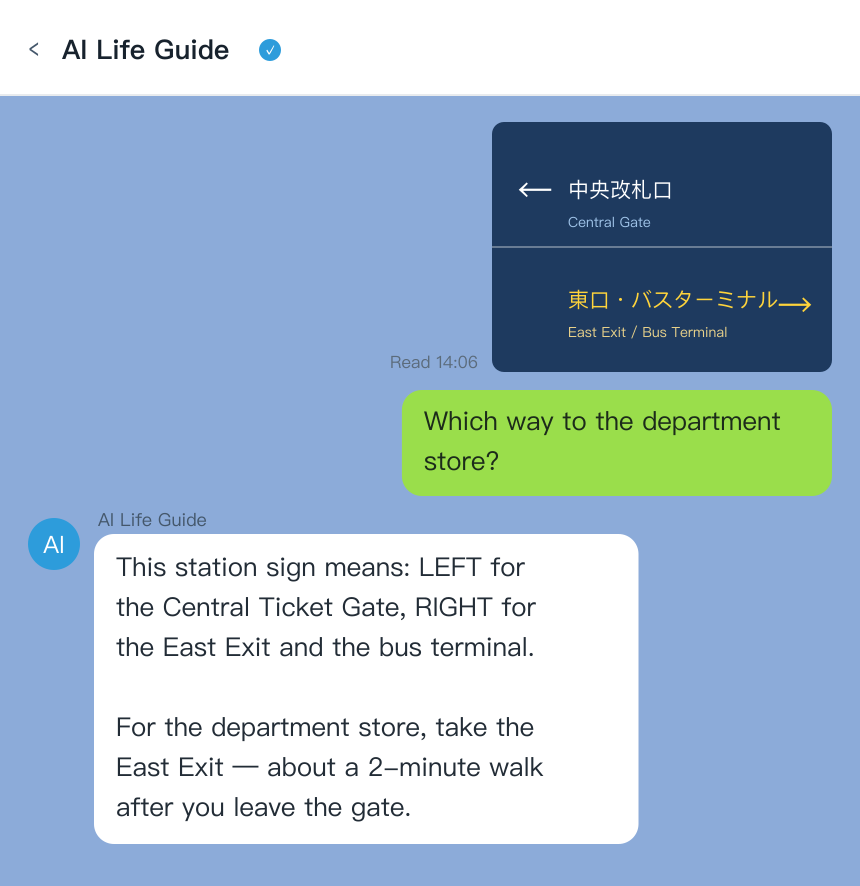
AI Life Guide demo: photograph a station exit sign or directory board to find out which exit gets you closest to your destination (simulated screenshot)
Photographing the overhead directory board — the one listing exit names alongside nearby landmarks, often only in Japanese at smaller stations — and asking which exit is closest to where you're headed turns a guess into a plan before you've committed to a direction.
5. IC card top-up and fare adjustment machines
Two machines cause most of the confusion at ticket gates: the top-up (チャージ, "charge") machine for adding value to a Suica, PASMO, or ICOCA card, and the fare adjustment machine (精算機) for when your card balance came up short at the exit gate. Both are usually clustered near the ticket gates, both are interactive touchscreens, and both are frequently Japanese-only or default to Japanese with a small, easy-to-miss English toggle in a corner.
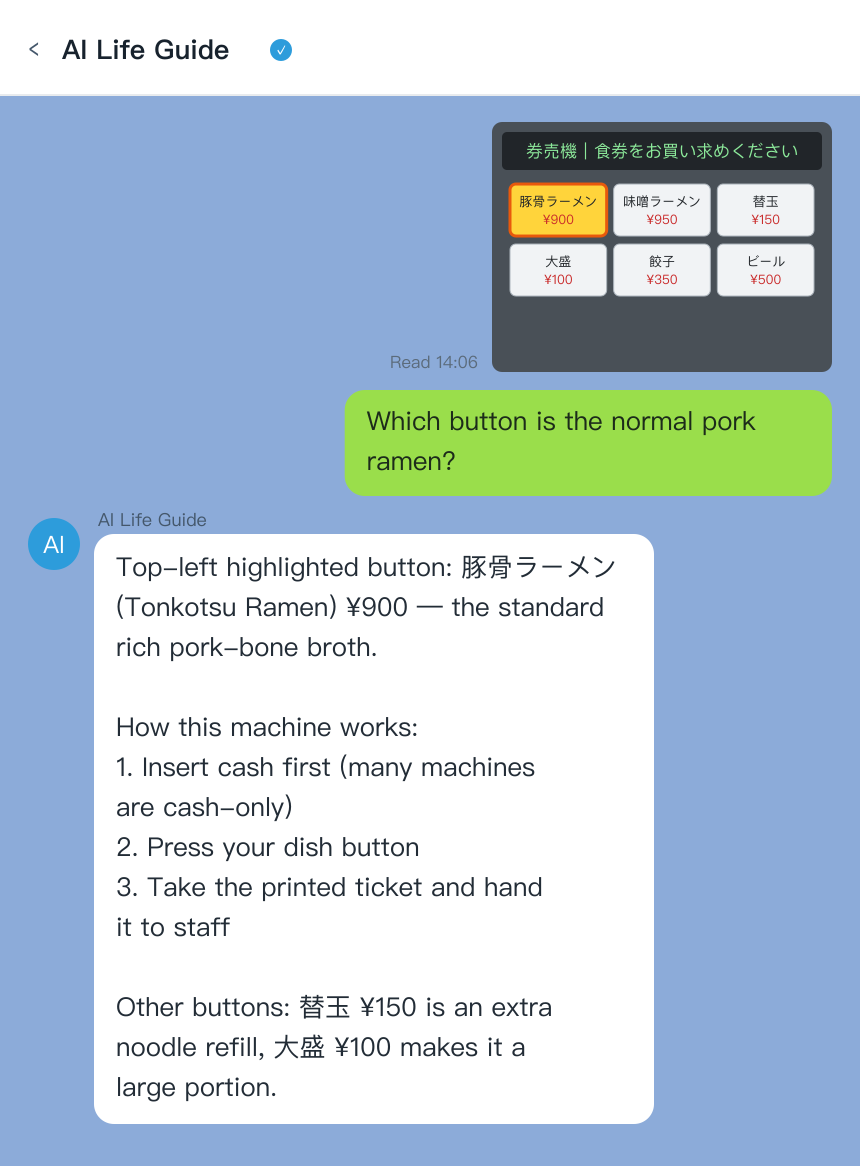
AI Life Guide demo: photograph an IC card top-up or fare adjustment machine screen to find out which button to press (simulated screenshot)
The fare adjustment machine specifically exists for a common, harmless situation: you tap in with an IC card, travel further than your card's remaining balance covers, and the exit gate stops you rather than letting you through negative. The machine reads your card, tells you the shortfall, and lets you pay the difference in cash or sometimes by card — then you tap out normally. It's a completely routine part of IC card travel, not a sign you've done something wrong, but the on-screen Japanese prompts can make a two-step process feel like a puzzle if you can't read them.
- Honest limit: a photo can tell you what a machine screen is asking for, but it can't press the button or insert the card for you — you're still doing the transaction yourself.
6. Delay and suspension notices
Service disruptions are announced on platform display boards and station-wide signage, usually in a mix of Japanese text, a few standard English terms, and sometimes an announcement in both languages. The trouble is that these notices vary a lot in how much English they include — a major disruption on a well-used line often gets bilingual signage quickly, while a smaller, single-line delay may only ever be posted in Japanese.
The key distinction to make quickly is between a delay (遅延 — the train is running late but will come) and a suspension (運転見合わせ — service is currently stopped, and you need an alternative route). Both are usually shown with a reason code and, for delays, an estimated wait; suspension notices sometimes include an estimated resumption time, but not always. Photographing the notice and asking whether it affects your specific line, and whether it's a delay or a full stoppage, is faster than trying to parse the kanji cold — and faster than assuming the worst and rebooking a route you didn't actually need to change.
- Term: 各駅停車 / 普通 | Meaning: Local — stops every station, base fare only
- Term: 快速 | Meaning: Rapid — skips some stations, base fare only
- Term: 急行 / 特急 | Meaning: Express / limited express — may need a surcharge
- Term: 指定席 | Meaning: Reserved seat — specific seat and time
- Term: 自由席 | Meaning: Non-reserved — any open seat in that car
- Term: 女性専用車 | Meaning: Women-only car, active during posted hours
- Term: 精算機 | Meaning: Fare adjustment machine — pay a shortfall at exit
- Term: 運転見合わせ | Meaning: Service suspended — need an alternative route
Honest limits
None of this replaces station staff when something has genuinely gone wrong — a major suspension, a missed last train, a lost item — where a human at the counter can act on your behalf in ways a photo-and-explain tool can't. What photographing a sign, board, or machine screen is good for is the much more common situation: understanding what's in front of you well enough to make your own next move, without waiting in line to ask someone who may not speak much English either.
Staring at a departure board or ticket machine you can't read? Add AI Life Guide on LINE (free) and photograph it for a plain-English read of what it says and what to do next.
FAQ
Q: What's the difference between local, rapid and express trains in Japan?
A: Local (各駅停車/普通) stops at every station and needs only a base fare. Rapid (快速) skips some stations but is still covered by the base fare. Express and limited express (急行/特急) skip more stations and can require an additional surcharge or a reserved-seat ticket — worth checking before boarding, since some of these trains don't accept a base fare alone.
Q: Do I need a reserved seat?
A: Only on trains and cars marked 指定席 (reserved). Cars marked 自由席 (non-reserved) let you sit in any open seat first-come-first-served. Sitting in a reserved seat without the matching ticket usually just means being asked to move once the seat's actual holder boards — not a serious problem, but easy to avoid by checking the car number against your ticket.
Q: What is the fare adjustment machine for?
A: The 精算機 (fare adjustment machine) is for when your IC card balance doesn't cover the full distance you traveled — it reads your card, shows the shortfall, and lets you pay the difference before you tap out at the gate. It's a routine, expected part of IC card travel in Japan, not a sign of an error.
Q: Can I ride a women-only car by mistake?
A: It's possible if you don't notice the pink signage or aren't aware of the time window — 女性専用車 designations typically apply only during specific rush-hour periods on certain lines, posted on both the platform and the train itself. Outside those hours the same car has no restriction, so checking the posted time window is the key detail.
Q: Which station exit should I take?
A: Check the overhead directory board near the ticket gates, which lists exit names (中央口/東口/西口/北口/南口, etc.) alongside nearby landmarks — in large stations, picking the wrong exit can mean a 10-15 minute walk to correct course, so it's worth a look before you start walking.
Bottom line
Route-planning apps have made getting from A to B in Japan genuinely easy — the part that's still hard is everything physically in front of you once you're at the station: which train is arriving, which seat is yours, which exit to take, and what a machine screen or delay notice is actually telling you. None of that is solved by better routing; it's solved by being able to read what's on the sign.
Navigating a big Japanese station on your trip? Add AI Life Guide on LINE (free) so every board, machine, and notice gets a plain-English read on the spot.
Further reading
- Getting Around Asia 2026: Transit Apps, IC Cards & How to Read Ticket Machines
- 10 Apps to Download Before Your Japan Trip (2026) — And the One Hiding Inside LINE
- Cash or Card in Japan 2026: Where You Still Need Yen, IC Cards, and ATMs That Take Foreign Cards
Sources
- Japan Tourism Agency traveler survey, 2024–2025
- JR and private railway station signage conventions, 2026
- Hands-on testing and traveler forum reports, 2026