Japan Drugstore Shopping (2026): Reading Labels and Knowing What You're Buying
A Japanese barcode-scanning app for product labels has 4.5 million downloads and a 99% foreign user base — proof that "what does this actually say" is one of the most common questions in a Japanese drugstore.
**Quick summary — 3-minute read**
• Payke, a barcode-scan app for Japanese product labels, has reached 4.5 million downloads with a 99% foreign user base — strong proof that "what does this product actually say" is a real, common need, not a niche one.
• Skincare and cosmetics carry specific label terms worth knowing: SPF/PA sunscreen notation, the 薬用 ("medicated") claim, and ingredient lists that don't map cleanly onto Western labeling conventions.
• Snack and souvenir food labels carry their own ingredient and allergen terms, separate from restaurant dining.
• Tax-free shopping has real rules — passport, minimum spend thresholds, and sealed-bag requirements for consumables — but check current thresholds rather than relying on a fixed number, since these can change.
• AI Life Guide can read a label's back panel and tell you what it says and roughly what's in it, but it isn't a dermatological or medical judgment about whether a product suits your skin or diet.
Payke, a Japanese app that lets you scan a product barcode for translated label information, has quietly become one of the more telling data points in Japanese tourism tech: 4.5 million downloads, with 99% of its users being foreign visitors rather than Japanese residents. That's not a niche curiosity — it's strong evidence that standing in a Japanese drugstore or supermarket aisle, holding a product you can't read, is a genuinely common moment for a huge number of travelers.
This guide is about that moment specifically — not restaurant menus or medicine boxes (that's a separate topic), but the shopping aisle: skincare, cosmetics, snacks, and souvenir food, plus how tax-free shopping actually works when you're ready to check out.
Why this is its own problem
Payke's strength is real but has real limits too: it works by matching a scanned barcode against a database, which means it only helps if the specific product is already in that database — a real constraint for smaller brands, regional-only products, or anything recently released. Its business model also leans on in-app advertising, which shapes the experience. An approach based on photographing and reading the label itself, rather than matching a barcode against a fixed database, doesn't have that coverage ceiling — any label that's physically legible can be read, whether or not anyone has previously logged that specific product.
That distinction matters because Japanese drugstores (ドラッグストア) stock an enormous range of skincare, cosmetics, and snack products that simply don't exist in Western markets, with packaging built entirely around Japanese-language conventions and regulatory terms that don't translate word-for-word.
Skincare and cosmetics label terms
Japanese sunscreen labeling uses two separate scales that don't map directly onto US or European sunscreen labels: SPF, the familiar UVB protection number, and PA, a separate scale (PA+ through PA++++) measuring UVA protection specifically. A product might be labeled "SPF50+ PA++++," and both halves matter — SPF alone doesn't tell you the UVA protection level the way it might on a label you're used to reading at home.
The term 薬用 (yakuyou, often translated "medicated") appears on a wide range of Japanese cosmetics and skincare, and it doesn't mean what "medicated" typically implies in English. It's a regulatory category in Japan (quasi-drug) indicating the product contains an active ingredient recognized to have a specific effect — whitening, acne treatment, anti-perspirant action — at a government-recognized concentration, sitting in a middle tier between ordinary cosmetics and full pharmaceuticals. It's a meaningful label to notice, but it's a regulatory classification, not a guarantee that a specific product suits your skin.
- Hair care products often distinguish between シャンプー (shampoo) and リンス or トリートメント (rinse/conditioner and treatment) — treatment products are typically a more intensive, often rinse-out formula rather than a daily conditioner, worth knowing before buying what looks like a simple two-bottle set.
- Ingredient lists (成分) are usually printed in a dense, small-type block on the back or side of the package, ordered by concentration much like Western products — but individual ingredient names are transliterated or translated in ways that don't always match the English/INCI names you might recognize.
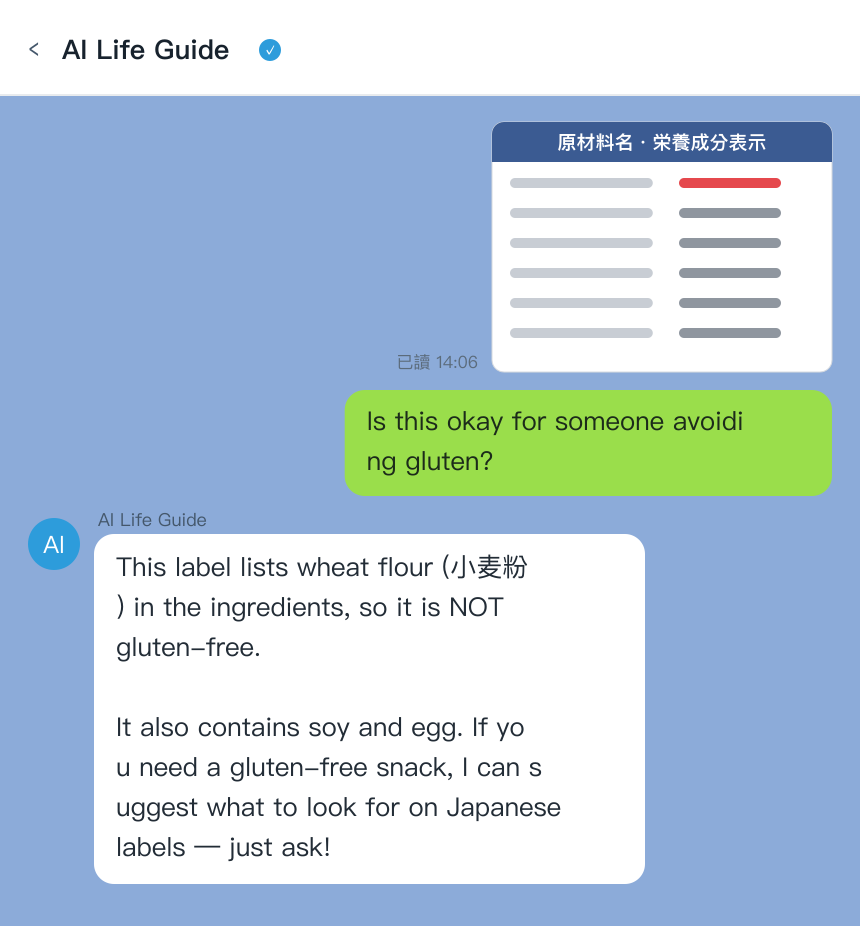
AI Life Guide demo: photograph the back label of a Japanese skincare product to check what it claims and roughly what's in it (simulated screenshot)
Snacks and souvenir food labels
Japanese snack and souvenir food packaging carries its own set of label conventions worth recognizing: 賞味期限 (best-before date) versus 消費期限 (use-by/expiration date) are two different date types with different meanings, and confusing them can mean either tossing something still perfectly fine or keeping something past a genuine safety cutoff. Allergen labeling in Japan is regulated but framed differently from US or EU standards — Japan mandates disclosure for a specific list of allergens (egg, milk, wheat, buckwheat, peanut, shrimp, crab, among others) that overlaps with but isn't identical to Western allergen-labeling lists.
For souvenir food specifically — the boxed sweets, regional specialties, and snack assortments that make up a huge share of Japanese retail tourism — ingredient lists are almost always Japanese-only, even at shops clearly set up for tourist traffic, since the products themselves are aimed primarily at the domestic gift-giving market (omiyage culture) rather than an export audience.
- Term: 薬用 | Meaning: Medicated / quasi-drug — recognized active ingredient at a set concentration
- Term: SPF / PA | Meaning: UVB protection (SPF) and separate UVA protection scale (PA+ to ++++)
- Term: 賞味期限 | Meaning: Best-before date — quality guideline, not a hard safety cutoff
- Term: 消費期限 | Meaning: Use-by / expiration date — a genuine safety cutoff
- Term: 成分 | Meaning: Ingredients list
- Term: 免税 | Meaning: Tax-free (duty-free) — passport and minimum spend required
How tax-free shopping actually works
Japan's tax-free (免税) shopping system lets eligible foreign visitors purchase certain goods without consumption tax at participating stores, shown by a tax-free counter or signage at checkout. The mechanics generally involve presenting your passport at the time of purchase (not after), and there are minimum spend thresholds that apply — but because these thresholds and the exact rules have changed over time and can change again, it's worth checking current requirements at the store's tax-free counter or Japan's official tourism resources rather than relying on a specific number that may be out of date by the time you travel.
Consumable goods (food, drinks, cosmetics, medicine) bought tax-free are typically sealed in a special bag at checkout, and that seal is meant to stay unbroken until you've left Japan — opening a sealed consumables bag before departure can create problems at customs, since the tax-free status assumes the goods are leaving the country unused. Non-consumable goods (clothing, electronics, general merchandise) don't carry the same sealed-bag requirement in most cases, but the passport-and-receipt requirement still applies, and customs can ask to see the physical goods matching your tax-free receipts at departure.
- Bring your passport to every purchase you intend to make tax-free — it's checked at the point of sale, not just at the airport.
- Keep tax-free receipts accessible until you've cleared departure, since they can be checked against the goods themselves.
- Ask the store's tax-free counter directly about current minimum spend thresholds — these are the kind of detail this guide deliberately doesn't quote a fixed figure for, since rules do change.
Product fit: reading the label you're actually holding
The through-line across skincare terms, snack labels, and allergen disclosures is the same one Payke's download numbers point to: travelers want to know what a specific product actually says, not a generic explanation of Japanese labeling conventions in the abstract. Photographing the back of a sunscreen bottle, a bag of rice crackers, or a box of sweets and asking what it says — what the 薬用 claim means for that product, whether that ingredient list contains a specific allergen, what that best-before date actually implies — turns a label you can't read into an answer you can act on before you buy, not after.
- Honest limit: reading a label and explaining what it says is not the same as a dermatological judgment about whether a specific skincare product suits your skin, or a medical judgment about whether a specific ingredient is safe for your particular allergy — when the stakes are real, that call belongs to a pharmacist, doctor, or dermatologist, not a photo-reading tool.
Standing in a Japanese drugstore aisle wondering what a label says? Add AI Life Guide on LINE (free) and photograph the back panel for a plain-English read.
FAQ
Q: How does tax-free shopping work in Japan?
A: Present your passport at the time of purchase at a participating store's tax-free counter, and your consumption tax is waived if you meet the current minimum spend threshold — check that threshold at the counter since it can change. Consumables are typically sealed in a special bag that should stay unopened until you've left Japan.
Q: What does 薬用 mean on Japanese cosmetics?
A: 薬用 (yakuyou) means "medicated" in a specific regulatory sense — it's a quasi-drug classification indicating the product contains a government-recognized active ingredient at a set concentration, aimed at a specific effect like whitening or acne treatment. It sits between ordinary cosmetics and full pharmaceuticals, but it's not a guarantee the product suits any particular person's skin.
Q: How do I check if a product contains something I'm allergic to?
A: Check the ingredient list (成分) printed on the package, and be aware Japan's mandated allergen disclosure list overlaps with but isn't identical to US or EU lists. Photographing the ingredient panel and asking whether it mentions your specific allergen is a useful first screen, but for a serious allergy, cross-check with a pharmacist or trusted translation of the full ingredient list rather than relying on any single read.
Q: Is Japanese sunscreen labelled differently?
A: Yes — alongside the familiar SPF (UVB protection) number, Japanese sunscreens use a separate PA scale (PA+ through PA++++) for UVA protection, which most Western sunscreen labels don't include in the same way. Both numbers matter when comparing products.
Q: Can I open tax-free items before leaving Japan?
A: For consumable goods, the sealed bag they're packed in at purchase is meant to stay unopened until you've departed — opening it early can cause problems at customs, since tax-free status assumes the goods leave the country unused. Non-consumable goods generally don't carry the same sealed-bag rule, but the receipt-and-passport requirement still applies at departure.
Bottom line
A Japanese drugstore aisle packs an enormous amount of information onto small, densely printed, Japanese-only labels — sunscreen notation, medicated-product claims, ingredient lists, expiration terms — and the fact that a barcode-scanning app for exactly this problem has reached 4.5 million downloads with a 99% foreign user base says the need is real, not niche. Reading the label you're actually holding, rather than a general guide to Japanese packaging conventions, is what actually answers "should I buy this."
Shopping for skincare or souvenirs on your Japan trip? Add AI Life Guide on LINE (free) and photograph the label before you buy.
Further reading
- 10 Apps to Download Before Your Japan Trip (2026) — And the One Hiding Inside LINE
- Cash or Card in Japan 2026: Where You Still Need Yen, IC Cards, and ATMs That Take Foreign Cards
- Menu Translation Apps for Asia 2026: Order Confidently in Japan, Korea, Thailand & Taiwan
Sources
- Payke public download and user-base figures, 2025-2026
- Japanese quasi-drug and allergen labeling regulations, 2025-2026
- Hands-on testing and traveler forum reports, 2026