Bangkok BTS vs MRT (2026): Why One Card Doesn't Work on Both
The Rabbit card that gets you through BTS gates does not work on the MRT, and BTS gates still don't take international contactless bank cards — here's the split explained.
**Quick summary — 3-minute read**
• Bangkok runs three separate rail systems — BTS Skytrain, MRT subway, and the Airport Rail Link — and they are not one unified network.
• The Rabbit card that works on the BTS does not work on the MRT, and the MRT has its own separate stored-value card.
• BTS gates still do NOT accept international contactless bank cards as of this writing — this is the number one reason tourists get stuck at the gate.
• Interchange stations between systems usually mean exiting through one set of gates and paying again to enter the other — there's no free transfer between BTS and MRT.
• Card acceptance rules change, so always verify current policy at the ticket counter rather than assuming last year's rule still applies.
Bangkok has three rail systems that all look, on a transit map, like one connected network — but operationally, they mostly aren't. The BTS Skytrain, the MRT subway, and the Airport Rail Link are run by different operators, use different fare cards, and in most cases require you to exit and re-enter, paying again, whenever you switch between them. This single fact causes more confusion for first-time visitors than almost anything else about getting around the city.
This guide explains why the systems are separate, what each one actually accepts as of this writing, where the genuine interchange points are, and when a boat or a rideshare beats fighting through a transfer altogether.
Three systems, three operators
The BTS Skytrain (the elevated lines, often just called "the Skytrain") is operated by Bangkok Mass Transit System PCL. The MRT (the underground and some elevated lines, including the Blue and Purple lines) is operated by Bangkok Expressway and Metro. The Airport Rail Link, connecting Suvarnabhumi Airport to the city center, is run by the State Railway of Thailand under a separate arrangement again. Each of these three organizations built and runs its own fare collection system, and — this is the part that surprises visitors — those systems were never fully unified into one card or one ticket.
This isn't a Bangkok-specific quirk born of poor planning; it reflects how the lines were built and expanded by different entities over different decades, with integration retrofitted only partially. The practical result for a traveler is that a "one card for all of Bangkok transit" mental model, reasonable in cities like Tokyo or London, doesn't hold here — and assuming it does is where most of the confusion starts.
What each system takes — and the Rabbit card gap
The BTS Skytrain uses the Rabbit card, its own rechargeable stored-value card, alongside single-journey tokens purchased from ticket machines or counters for one-off trips. The MRT uses an entirely separate stored-value card of its own, plus its own single-journey tokens sold from its own machines. A Rabbit card loaded with value and working perfectly at every BTS gate you've used all week will simply not be accepted at an MRT gate — the systems don't share a backend, and a card issued by one operator has no standing on the other's network.
The other major point of confusion: BTS gates still do NOT accept international contactless bank cards (a tap-to-pay Visa or Mastercard) as of this writing. Travelers arriving from cities where contactless bank card payment has become the default way to ride transit — London, Sydney, New York's subway in recent years — often assume the same will work in Bangkok, tap their card at the gate, and get stuck. This is consistently reported as the single most common point of confusion for first-time BTS riders, precisely because it contradicts an assumption that's become reasonable almost everywhere else.
- Because card acceptance policies do change over time, verify current acceptance at a BTS or MRT ticket counter before relying on any specific payment method for your trip — don't assume last year's (or last month's) rule still holds.
- The Airport Rail Link has its own single-journey tokens and, at various points, its own stored-value card arrangements — treat it as a fourth system for payment purposes, not an extension of either the BTS or MRT card.
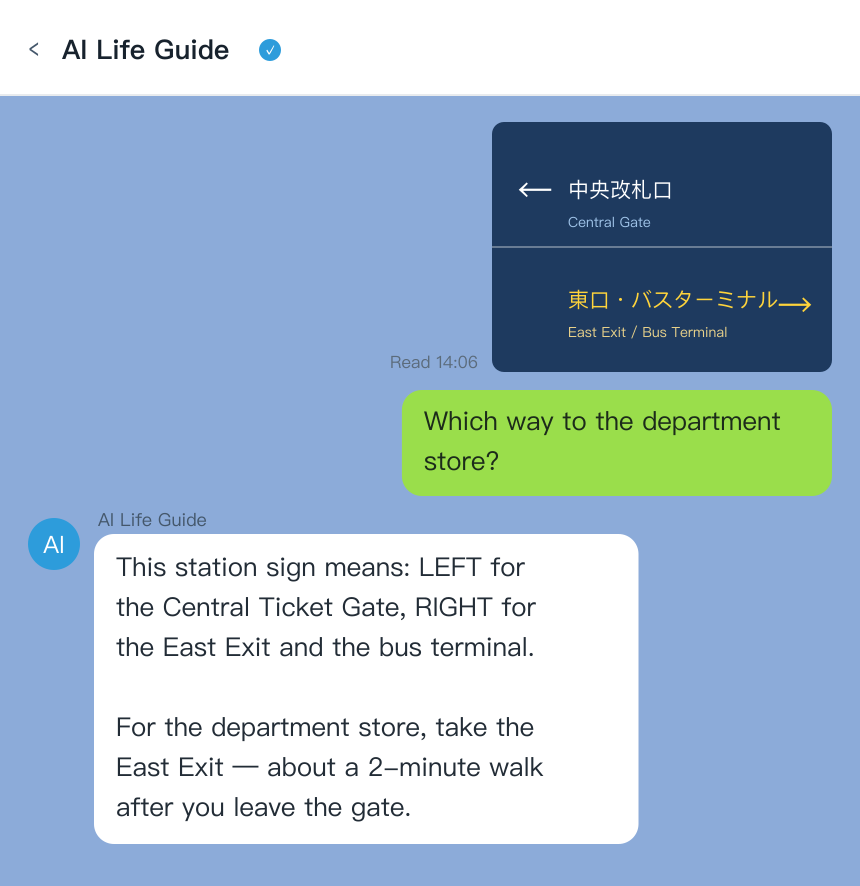
AI Life Guide demo: photograph a BTS or MRT fare chart or ticket machine screen to check what it accepts before you queue at the gate (simulated screenshot)
Fare charts posted at ticket machines and station entrances usually list accepted payment methods, but the text is often small, mixed with route and price information, and easy to misread quickly in a crowded station. Photographing the fare chart or the ticket machine screen and asking what payment methods it accepts, before you're already queued at the gate, saves the awkward moment of being turned away and having to start over.
Interchange stations: exit, re-enter, pay again
Several stations sit at genuine interchange points between BTS and MRT — Asok/Sukhumvit, Siam (BTS) connecting to nearby MRT stations, Mo Chit/Chatuchak Park among them — and it's tempting to assume these function like interchange stations in cities with unified fare systems, where you simply walk from one platform to another. They mostly don't work that way here: switching from BTS to MRT (or the reverse) at these points generally means exiting through one system's paid gates and re-entering through the other's, paying a separate fare each time, because you're moving between two fare-collection systems that don't recognize each other's payment.
This is worth planning for specifically on a multi-leg trip: a journey that looks like one connected route on a combined transit map may actually be two separate paid trips in practice, with a walk between gates in between. Budgeting a few extra minutes — and a second fare — for any journey that crosses between BTS and MRT avoids the surprise of realizing partway through that your "one trip" was actually two.
- System: BTS Skytrain | Own card: Rabbit card | Contactless bank card: Not accepted as of writing
- System: MRT | Own card: Separate MRT stored-value card | Contactless bank card: Verify at counter
- System: Airport Rail Link | Own card: Separate token/card arrangement | Contactless bank card: Verify at counter
When the boat or a Grab beats the train
Bangkok's Chao Phraya Express Boat and canal boat services cover a meaningful part of the city that neither BTS nor MRT reaches directly, and for routes that run roughly parallel to the river, a boat can be faster than a train-plus-transfer combination, with the added benefit of skipping fare-system confusion entirely since boats have their own simple ticketing. For routes that don't align well with any rail line, or for late-night travel after trains stop running, Grab (Southeast Asia's dominant rideshare app) is often the more practical choice than piecing together a multi-leg rail journey — particularly for groups, where a shared Grab fare can undercut multiple individual train tickets anyway.
The general rule worth internalizing: check whether your route requires a BTS-to-MRT interchange before committing to it, since that's specifically where confusion and double-paying happen — a straightforward BTS-only or MRT-only trip is simple and fast, while a trip crossing both systems is where the friction concentrates.
Rush hour reality
Both BTS and MRT get genuinely crowded during Bangkok rush hours (roughly 7-9am and 5-7pm on weekdays), with platform crowd control staff sometimes limiting boarding to manage flow at the busiest interchange stations. This isn't unique to Bangkok, but it compounds the interchange-station friction described above — the worst possible combination is a BTS-to-MRT transfer during peak rush hour, since you're exiting one crowded paid area, walking through a crowded connecting passage, and re-entering another crowded paid area in sequence. If your schedule allows any flexibility, shifting a multi-system transfer trip outside peak hours makes a meaningful difference.
Product fit: reading the fare chart or ticket machine on the spot
The recurring theme across all of this — three separate systems, cards that don't cross over, gates that reject certain payment methods — is that the information you need to avoid a mistake is usually posted somewhere at the station, just not always in a form that's quick to parse under time pressure. Photographing a fare chart, a ticket machine screen, or a station map and asking what it says works the same way here as it does for a menu or a sign: it doesn't replace checking with staff for anything that actually matters (like current fares, which we don't quote here since they change), but it turns an unreadable wall of small text and Thai script into a plain-English answer to "what does this actually say."
- Honest limit: never invented or guessed fares here deliberately — always check the current posted fare chart or ask at the counter, since fares and payment policies both change.
Standing at a BTS or MRT gate wondering what it takes? Add AI Life Guide on LINE (free) and photograph the fare chart or machine screen for a plain-English read.
FAQ
Q: Does the Rabbit card work on the MRT?
A: No. The Rabbit card is issued by and works on the BTS Skytrain only — the MRT operates on a completely separate stored-value card system. A Rabbit card loaded with value and working fine on BTS gates all week will not be accepted at an MRT gate.
Q: Can I tap my Visa/Mastercard at BTS gates?
A: BTS gates still do NOT accept international contactless bank cards as of this writing — this is consistently the number one reason first-time riders get stuck at the gate, especially if they're used to tap-to-pay transit in other cities. Because policies can change, verify current acceptance at a BTS ticket counter before relying on it.
Q: How do I buy a single BTS ticket?
A: BTS ticket machines sell single-journey tokens — select your destination station on the machine's map or screen, pay the fare shown (usually cash or coins, sometimes card depending on the machine), and the machine dispenses a token you tap at the gate. Station staff at the counter can also sell tokens directly if the machine is confusing or out of order.
Q: Is a day pass worth it in Bangkok?
A: It depends entirely on how many rides you'll take that day and on which system — BTS and MRT sell separate day passes for their own networks only, so a day pass doesn't cover both. Whether it's worth it comes down to your planned number of trips versus the pass price on the day; check current pricing at the counter rather than assuming a fixed number of rides breaks even.
Q: How do I transfer between BTS and MRT?
A: At shared interchange points like Asok/Sukhumvit or Mo Chit/Chatuchak Park, you generally exit through one system's paid gates and re-enter through the other's, paying a separate fare each time — there is no free, gate-to-gate transfer between the two systems in most cases. Budget a few extra minutes and a second fare for any trip that crosses between them.
Bottom line
Bangkok's BTS, MRT, and Airport Rail Link look like one network on a map but run as three separate businesses underneath — different cards, different gates, and in the BTS's case, no acceptance of international contactless bank cards at all as of this writing. Knowing that going in, checking which system your route actually needs, and budgeting for a second fare at any interchange saves the single most common frustration first-time visitors report about getting around the city.
Riding the Skytrain or MRT for the first time? Add AI Life Guide on LINE (free) and photograph any fare chart or machine screen you're unsure about.
Further reading
- Getting Around Asia 2026: Transit Apps, IC Cards & How to Read Ticket Machines
- 10 Apps to Download Before Your Thailand Trip (2026) — Grab, LINE, and the AI That Reads Thai for You
- Paying in Thailand as a Foreigner (2026): Why PromptPay QR Won't Work, ATM Fees, and What Does
Sources
- BTS and MRT operator public information, 2026
- TAT/Visit Thailand traveler resources, 2025-2026
- Hands-on testing and traveler forum reports, 2026